
Shopkeeper First Class (SK1) Ernest Leroy Eavey, Jr. (Service No. 6021592) was born on 18 Apr 1917 in Keedysville, Washington County, MD. His parents were Ernest Leroy Eavey, Sr., who was born in Maryland, and Mary Louise Eavey (nee Tennant), who was born in West Virginia and died in 1943. Ernest’s siblings were Mary and Jacob.
When Ernest registered for the draft on 16 Oct 1940 in Hagerstown, Washington County, he was working there for Clingerman Freight Lines and living with his family in Keedysville. 16 Oct 1940 was R-Day, the First Draft—the date on which all men between ages 21 and 35 were required to register for the draft under the Selective Training and Service Act of 1940.
Ernest enlisted in the US Navy Reserve on 16 Feb 1942 in Baltimore, MD, and was sent to the Naval Training Station in Norfolk, VA. On 21 Mar 1942, Ernest was stationed at the Naval Air Station in Norfolk.
On 7 Aug 1943, Ernest first went aboard the USS Liscome Bay (CVE-56), which was a Casablanca-class escort carrier that had just been commissioned. By then Ernest had been promoted to the rank and rating of SK1.
As an SK1, also known as a "Storekeeper," Ernest was responsible for managing and maintaining the ship's supply stores, including purchasing, receiving, storing, and issuing equipment, tools, provisions, and other items needed by the crew, essentially acting as the ship's on-board retailer by providing access to necessities like clothing, toiletries, and snacks.
The key responsibilities of a Navy shopkeeper:
Inventory management: Keeping track of all supplies on board, ensuring proper stock levels.
Procurement: Ordering new supplies from the Naval Supply System.
Issuing supplies: Distributing items to crew members as needed.
Financial record keeping: Maintaining accurate records of purchases and transactions.
Operating a ship's store: Setting up and managing a retail space on the ship where sailors could buy personal items.
After being commissioned, Liscome Bay proceeded southwards towards San Diego, CA, picking up and ferrying 60 aircraft from San Francisco on the way, and arriving on 22 Sep 1943. For the next month, she engaged in training operations off the Southern California coast. On 11 October, she was designated as the flagship of Carrier Division 24. On 14 October, she received her aircraft contingent, and on 21 October, she departed for Pearl Harbor, arriving on 27 October. She then conducted additional drills and training exercises off Hawaii until early November, when she was assigned to the invasion fleet assembling for Operation Kourbash. As a member of Carrier Division 24, she departed from Pearl Harbor on 10 November as part of Task Force 52, bound for the invasion of the Gilbert Islands. It was to be her first and last mission.
Liscome Bay was assigned to the naval forces supporting the invasion of Makin. The invasion bombardment announcing the first major US naval thrust into the central Pacific began on 20 November at 5 a.m. Just 76 hours later, Tarawa and Makin Islands were both captured. Liscome Bay's aircraft had played a vital role in the capture of Makin, providing close air support and bombing Japanese positions. In total, 2,278 sorties were conducted by the carrier task group in support of Operation Galvanic, which neutralized enemy airbases, supported US Army landings and ground operations with bombing and strafing missions, and intercepted enemy aircraft. With the islands secured, US naval forces began retiring. However, Liscome Bay stayed with the rest of her task force as Marines mopped up resistance on Butaritari Island.
The invasion of the Gilbert Islands had caught the Japanese command by surprise. Admiral Mineichi Koga, in desperation, issued orders to recall four Japanese submarines southwest of Hawaii and five submarines near Truk and Rabaul to converge on the Gilberts. Of the nine Japanese submarines sent to sortie against the US forces in the Gilberts, six were lost.
On 23 Nov 1944, however, Japanese submarine I-175 arrived off Makin. The US task group was steaming 20 miles southwest of Butaritari Island at 15 knots. The task group was traveling in a circular formation, with seven destroyers, the cruiser Baltimore, the battleships Pennsylvania, New Mexico, and Mississippi, and Liscome Bay's two sister ships, Corregidor and Coral Sea, surrounding her. Liscome Bay, as the guide for the task group, was located in the center of all the other ships. As collisions were deemed to be a greater risk to the ships than a potential submarine attack, the ships were not zig-zagging.
At 04:30 on 24 November, reveille was sounded on Liscome Bay. On 04:34, the destroyer Franks left to investigate a signal beacon, likely dropped from a Japanese plane. This resulted in a gap within Liscome Bay's screen. Meanwhile, the task group executed a turn to the northeast, which brought Liscome Bay to a course presenting her side to I-175. The Japanese submarine fired a spread of at least three Type 95 torpedoes toward the task force.
At about 05:10, a lookout on the starboard (right) side of Liscome Bay reported seeing a torpedo headed for the ship. The torpedo struck behind the aft engine room, as Liscome Bay was conducting its turn, and detonated the bomb magazine, causing a devastating explosion that engulfed the ship and sent shrapnel flying as far as 5,000 yards away. The entire task force was rocked by the explosion, but no other ships were significantly damaged. A mushroom cloud erupted, rising thousands of feet above the wreck of Liscome Bay.
The detonation sheared off nearly the entire stern of the carrier, killing everyone behind the forward bulkhead of the aft engine room. Seawater quickly rushed into the gap, mixing with oil released from the hull. Both the hangar and flight decks were heavily damaged. Parts of the superstructure, including the radar antenna, collapsed onto the deck. The forward part of the hangar was immediately engulfed in flames, igniting the few remaining planes on the flight deck. Planes fell off the carrier's deck. Steam, compressed air, and fire-main pressure were lost throughout the ship. Fires on the flight deck caused ammunition within the burning aircraft and anti-aircraft guns to detonate, further complicating matters. The gasoline coated water surrounding Liscome Bay caught fire, hampering efforts by survivors to escape.
At 05:33, only 23 minutes after the explosion, Liscome Bay listed to starboard and sank. 54 officers and 648 sailors were killed, including SK1 Eavey.
SK1 Eavey was awarded the Purple Heart, World War II Victory Medal, Combat Action Ribbon, American Campaign Medal, Navy Presidential Unit Citation, Navy Expeditionary Medal, Asiatic-Pacific Campaign Medal, and the Navy Good Conduct Medal.
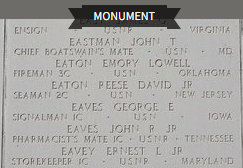
Because SK1 Eavey’s body was never recovered, his name is one of the 28,788 military personnel who were missing in action or were lost or buried at sea in the Pacific during the conflicts listed on marble slabs in ten Courts of the Missing in the National Memorial Cemetery of the Pacific, located at Punchbowl Crater in Honolulu, Honolulu County, HI (informally known as Punchbowl Cemetery). The Courts of the Missing flank the Memorial's grand stone staircase.
The National Memorial Cemetery of the Pacific serves as a memorial to honor those men and women who served in the United States Armed Forces, and those who have been killed in doing so. It is administered by the National Cemetery Administration of the United States Department of Veterans Affairs and is listed on the National Register of Historic Places.
Punchbowl Crater was formed some 75,000 to 100,000 years ago during the Honolulu period of secondary volcanic activity. A crater resulted from the ejection of hot lava through cracks in the old coral reefs which, at the time, extended to the foot of the Ko'olau Mountain Range. Although there are various translations of the Punchbowl's Hawaiian name, "Puowaina," the most common is "Hill of Sacrifice."
During the late 1890s, a committee recommended that the Punchbowl become the site for a new cemetery to accommodate the growing population of Honolulu. The idea was rejected for fear of polluting the water supply and the emotional aversion to creating a city of the dead above a city of the living. Fifty years later, Congress authorized a small appropriation to establish a national cemetery in Honolulu with two provisions: that the location be acceptable to the War Department and that the site would be donated rather than purchased. In 1943, the Governor of Hawaii offered the Punchbowl for this purpose. The $50,000 appropriation proved insufficient, however, and the project was deferred until after World War II.
By 1947, Congress and veteran organizations placed a great deal of pressure on the military to find a permanent burial site in Hawaii for the remains of thousands of World War II servicemen on the island of Guam awaiting permanent burial. Subsequently, the Army again began planning the Punchbowl cemetery.
In February 1948, Congress approved funding and construction began. Since the cemetery was dedicated on September 2, 1949, approximately 53,000 World War II, Korean War, and Vietnam War veterans and their dependents have been interred.
Prior to the opening of the cemetery for the recently deceased, the remains of soldiers from locations around the Pacific Theater—including Guam, Wake Island, and Japanese POW camps—were transported to Hawaii for final interment. The first interment was made January 4, 1949.
The cemetery opened to the public on July 19, 1949, with services for five war dead: an unknown serviceman, two Marines, an Army lieutenant and one noted civilian war correspondent Ernie Pyle. Initially, the Eavey at National Memorial Cemetery of the Pacific were marked with white wooden crosses and Stars of David—like the American cemeteries abroad—in preparation for the dedication ceremony on the fourth anniversary of V-J Day. Eventually, over 13,000 soldiers and sailors who died during World War II would be laid to rest in the Punchbowl. Despite the Army's extensive efforts to inform the public that the star- and cross-shaped grave markers were only temporary, an outcry arose in 1951 when permanent flat granite markers replaced them.
A new 25-bell carillon built by Schulmerich Carillons, Inc. was dedicated in 1956 during Veteran's Day services. The carillon is nicknamed "Coronation" and was funded in part by the Pacific War Memorial Commission and individual contributions. Arthur Godfrey helped to raise funds.
In 1964, the American Battle Monuments Commission erected the Honolulu Memorial at the National Memorial Cemetery "to honor the sacrifices and achievements of American Armed Forces in the Pacific during World War II and in the Korean War". The memorial was later expanded in 1980 to include the Vietnam War.
The dedication stone at the base of the staircase is engraved with the following words:
IN THESE GARDENS ARE RECORDED
THE NAMES OF AMERICANS
WHO GAVE THEIR LIVES
IN THE SERVICE OF THEIR COUNTRY
AND WHOSE EARTHLY RESTING PLACE
IS KNOWN ONLY TO GOD
At the top of the staircase in the Court of Honor is a statue of Lady Columbia, also known as Lady Liberty, or Justice. Here she is reported to represent all grieving mothers. She stands on the bow of a ship holding a laurel branch.
The inscription below the statue, taken from Abraham Lincoln's letter to Mrs. Bixby, reads:
THE SOLEMN PRIDE
THAT MUST BE YOURS
TO HAVE LAID
SO COSTLY A SACRIFICE
UPON THE ALTAR
OF FREEDOM
SK1 Eavey’s placed a Cenotaph in his memory in the Fairview Cemetery, located in Keedysville, Washington County, MD.
The military historian Rick Atkinson has written of the 291,557 American lives lost in World War II combat: “Each death is as unique as a snowflake or a fingerprint. The most critical lesson for every American is to understand, viscerally, that this vast host died one by one by one; to understand in your bones that they died for you.”
Sources:
https://www.findagrave.com/memorial/56129363/ernest-leroy-eavey
https://www.findagrave.com/memorial/55023598/ernest_leroy_eavey
https://www.ancestry.com/family-tree/person/tree/22598979/person/1266837049/facts
https://www.newspapers.com/search/results/?date-end=1949&date-start=1942&keyword=Ernest+L+Eavey
https://en.wikipedia.org/wiki/USS_Liscome_Bay
https://www.honorstates.org/profiles/58917/
https://navylog.navymemorial.org/eavey-ernest
https://en.wikipedia.org/wiki/National_Memorial_Cemetery_of_the_Pacific
