
LOST AT SEA - SINKING OF USS S-4 (SS-109) - 12/17/1927
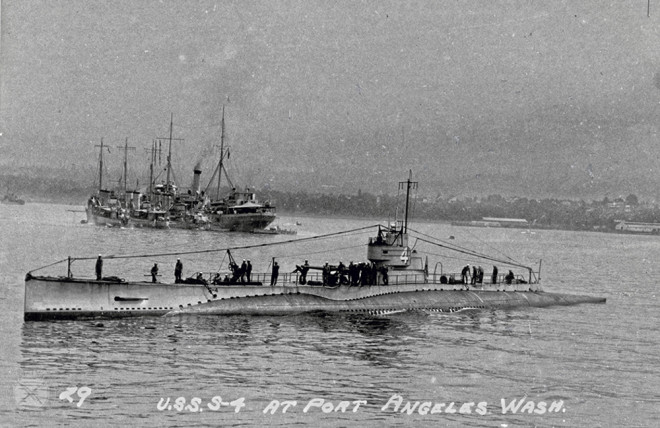
Submarine USS S-4 (SS-109) was built at Portsmouth Navy Yard and commissioned November 19, 1919. On December 17, 1927, USS S-4 conducted speed and maneuverability tests over a measured mile offshore from Provincetown, Massachusetts, and as she rose to the surface she was inadvertently struck by USCGC Pauline which was returning to port from a search for rumrunners. The ship was doing 18-knots and when a lookout spotted a periscope he ordered “Hard astern! Full right rudder!” but it was too late and USS S-4 was struck just ahead of the deck gun punching two large holes, in a ballast tank and penetrating the pressure hull into the battery compartment. Crewmembers tried to stuff clothing into the hole but were unsuccessful as USS S-4 settled 102 feet to the muddy bottom. Quickly six men sealed themselves into the forward torpedo room and the other crew members sealed themselves in two aft compartments. It soon became evident that USS S-4 could not reach the surface on its own and the men had to await rescue on the bottom.
Unfortunately, there was no rescue equipment nearby, and gale force winds and rough seas prevented a quick response. When rescuers were able to reach USS S-4 the following day they found air from the submarine to be 7% carbon-dioxide, too high for anyone to survive. Although the six men in the forward torpedo room had cleaner air and were able to survive for several days, all men in the aft compartments apparently died the day of the sinking. Because of the extremely foul weather, all rescue attempts were unsuccessful and the forty men aboard the submarine died. It took the Navy three months until March 1928 to finally raise USS S-4 and recover their bodies.
Commissaryman Second Class Dewey Victor Haney was one of the men to die in an aft compartment. Readily available historical public records reveal little information concerning him in addition to the details of his death. He was reportedly born November 30, 1902, in West Liberty, Kentucky, and is buried at Vernon Cemetery in Lyra, Ohio.
The sinking of USS S-4 was a pivotal point in the history of submarine design, and the painful inability of the Navy to be able to rescue the crew became the basis for an effort to make submarine escape and salvage a viable option. Although they all died, the USS S-4 crew left a legacy that has resulted in saving an untold number of others because of the improved safety and navigation required after the USS S-4 accident.
Submitted by CDR Roy A. Mosteller, USNR (Ret)
