
COAST GUARD AVIATOR #1
PILOT OF NC-4 - FIRST PLANE TO
FLY ACROSS ATLANTIC OCEAN
Elmer Fowler Stone was born January 22, 1887, in Livonia, New York. In 1910 he entered the Coast Guard Revenue Cutter Service Academy (later became the U.S. Coast Guard) and upon graduation in June 1913 was commissioned a Third Lieutenant. During World War One, Stone was assigned to the Navy cruiser USS Huntington and made several convoy escort patrols across the Atlantic. Next assigned to USRC Onondaga, Stone suggested the Coast Guard develop an aviation capability and with encouragement of his commanding officer, he approached the Curtiss Flying School in Newport News, Virginia, about using aircraft in air-sea rescue operations. In April 1917 Stone became Coast Guard’s Aviator #1 and Naval Aviator #38 upon graduating from flight training at the Navy Flight School at Pensacola, Florida. On October 2, 1917, Stone was assigned to the Navy Aeronautic Station at Rockaway, New York.
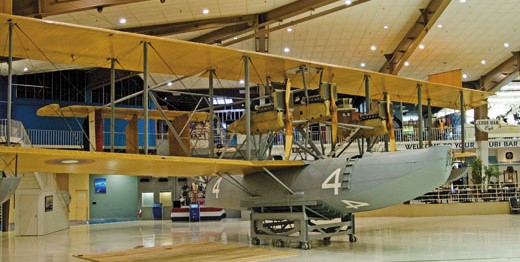
In 1919 the Navy sought to demonstrate that floatplanes were capable of transatlantic flight, thus four NC float aircraft were built, and Stone was chosen to be one of six crewmen assigned to NC-4. On May 16, 1919, three of the planes departed New York, destination Lisbon, Portugal. Unfortunately, two of the aircraft were damaged and lost during the flight and only NC-4 reached Lisbon on May 27, becoming the first aircraft to fly across the Atlantic. Stone was one of the two pilots aboard NC-4 for the historic flight which was not without problems as the plane encountered mechanical problems along the way, the four engines developed oil leaks, and one engine had to be replaced because of a broken connecting rod. The complete trip was 3,936 nautical miles and took 23 days. Flight time was 57-hours 16-minutes as the maximum speed of NC-4 was 85MPH and service ceiling was 2,500 feet. NC-4 was donated to the Smithsonian Institution but as it is too large to be housed in Washington, D.C., it is on permanent loan to the National Museum of Naval Aviation in Pensacola, Florida.
For the next six years Stone was assigned to the Navy’s Bureau of Aeronautics where he assisted in the development of catapults and arresting gear aboard new Navy aircraft carriers. He continued to promote Coast Guard aviation during the 1920s and after a tour at sea, Stone became the Commanding Officer of the Coast Guard Aviation Unit at Clape May, New Jersey, where he continued to develop his skill at making open-ocean landings. On April 5, 1933, Stone put his landing skills to the test when the Navy dirigible Akron crashed off the Atlantic coast during a storm. Stone was the only pilot available and willing to attempt a landing during the storm. His last duty assignment was as Commanding Officer of the Coast Guard Air Patrol Detachment in San Diego. On May 20, 1936, while inspecting a new aircraft he suffered a heart attack and died. He is buried at Arlington National Cemetery where his pallbearers included officers from the Coast Guard and the Navy.
NAVY CROSS CITATION
The President of the United States of America takes pleasure in presenting the Navy Cross to Lieutenant Elmer Fowler Stone, United States Coast Guard, for distinguished service in the line of his profession as a member of the crew of seaplane NC-4, in making the first successful Trans-Atlantic flight.
Submitted by CDR Roy A. Mosteller, USNR (Ret)
