

GILLCRIST-PAUL
PAUL THOMAS GILLCRIST
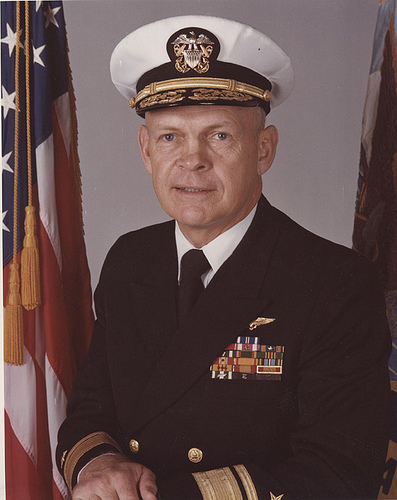

RADM

NIGHT EJECTION FROM A STRICKEN JET
Paul Thomas Gillcrist graduated from the Naval Academy, Class of 1952, and went on to excel as a Naval Officer, Aviator, and Test Pilot in a career which spanned 33-years. After his retirement he wrote several books about his experiences in Naval Aviation and the following are excerpts from “FEET WET, REFLECTIONS OF A CARRIER PILOT” published in 1990:
November 9, 1966, began as did most workdays. The alarm rang at 0530 and I shut it off after the first ring. It was with good feelings that I sat down in the ready room at NAS Miramar and briefed an unexciting night intercept training mission. My wingman and I would go to our assigned stations offshore and run intercepts on each other in our F-8Es. The departure from NAS Miramar was uneventful. It was a crystal clear, moonless night with plenty of starlight. As I passed through 37,000 feet to my altitude of 40,000-feet a tremendous compressor stall jolted the airplane. It sounded as loud as a 20mm shell exploding inside the cockpit. Quickly scanning the instruments I saw the engine RPM needle unwinding. Damn! A flameout.
I attempted several engine starts. “My God, its’s quiet in here,” I thought. All I could hear was the steady chirping in my earphones which told me the engine igniters were firing but the RPM needle never flickered. It’s a long way to those white lights of the coast and that water is very cold. Without an exposure suit I would be good for only about twenty minutes before becoming too numb to function well. I spoke, “Mayday, Mayday. This is Firefighter Two Zero One,” the calmness of my voice surprised me. “At 35,000 feet and gliding toward El Toro area, unable to restart. Anticipate ejection when I get to 10,000. Request any assistance for a water recovery near the coastline. Over.”
Response was startlingly clear and immediate as El Toro Tower told me help was nearby. As I passed through 11,000 feet I estimated I was about three miles off the coast and I rolled the airplane directly away from the lights on the beach and everything was black in front of me. I grabbed the face curtain handle and yanked down hard. There was a tremendous explosion as the system fired the seat up the rails into the night. As the wind blast hit me, I felt myself complete one forward tumble and the opening jolt of the parachute deploying. It was deathly still. The quietest place in the world is descending in a parachute over water at night.
I quickly knew something was terribly wrong. The web of the parachute shroud lines was wrapped around my neck, helmet and upper body. I got out my parachute shroud cutter, a switchblade jackknife with a razor sharp hooked blade and cut the line wrapped around my neck. My eyes widened in horror as I saw the ejection seat tangled in the shroud lines above my head.
Looking down I saw the lower half of my seat pan shell had not opened so the life raft had not deployed. I pried the lower shell away and the life raft tumbled out but there was no familiar hiss of the carbon dioxide bottle inflating the raft.
I could tell precisely when I was going to hit and I had each hand on a shoulder harness release snap as I did. I was surprised how far below the surface I went. Coughing out seawater as I surfaced, I found the right harness hadn’t released. The ejection seat was now below me and still connected and I was being pulled below the surface. I took a deep breath and pulled the two toggles on the floatation vest. The positive buoyancy it gave me was barely balanced by the weight of the ejection seat. Stroking with both hand I got back to the surface, choking on seawater and gasping for air. I found the shroud cutter and in about ten strokes cut through four layers of nylon in the shoulder harness. I was now free on top but still attached to the parachute. I took a deep breath, reaching down, frantically slashing at the lines around my ankle. Adrenaline had kept the 52-degree water from numbing me but my arms were beginning to feel like lead. Finally I was able to cut away most of the shroud lines wrapped around my ankle and was floating higher in the water although still going under with each passing swell.
I heard the sound of a rescue helicopter pass about fifty feet overhead dragging a rescue horse collar at about 5-miles an hour. I could not reach it. I heard the helicopter coming again and saw the horse collar skipping along just out of my reach. It dawned on me that he couldn’t hover as it was dark, moonless with no horizon so he could not stay motionless over the ocean. I realized I was running out of time as I couldn’t feel anything below the waist. I loaded six flare rounds into my revolver and the next time he came around I fired them a few feet in front of the windscreen. The helo came to a screeching halt, the horse collar stopped about ten feet away and I took 3 or 4 frantic strokes, grabbing the collar just as it started to drift away. I could not get into the collar properly so I locked my arms together and gave the crewmen the thumbs-up signal to hoist away. About 30-feet above the water I slid to the bottom of the sling. One arm was locked around the horse collar and a cable fitting ripped a 2-inch gash into my bicep. I didn’t care. I was hanging on for dear life when I felt hands grab me and haul me into the cabin.
NOTE: RADM Paul Thomas Gillcrist died on June 30, 2016 and has been buried at Miramar National Cemetery in San Diego.
Submitted by CDR Roy A. Mosteller, USNR (Ret)