
POW IN NORTH VIETNAM FOR ALMOST 8 YEARS
Raymond Arthur Vohden was born November 30, 1930, in Summit, New Jersey. He graduated from high school in Springfield, New Jersey, having earned nine varsity letters in four different sports and often competed in both track and baseball on the same day. He graduated in 1952 from Rutgers University where he was on the wrestling team and won the New Jersey and Eastern Regional A.A.U. championships. He earned seven varsity letters at Rutgers in three sports. He enlisted in the Navy in January 1953, earned his Naval Aviator wings in 1954, and flew fighter jets for four years. In 1958 he became a flight instruction where he served for three years. In 1961 he was assigned as a catapult officer on the carrier USS Constellation, and in 1964 became a jet attack pilot with Attack Squadron Two-hundred Sixteen aboard the carrier USS Hancock.
On April 3, 1965, then LCDR Vohden flew from Hancock as the pilot of an A-4C Skyhawk bomber to attack the Dong Phuong Bridge located south of Hanoi, North Vietnam, a vital supply bridge on the supply route for troops and equipment headed south. LCDR was the leader of the second of three divisions of aircraft that attacked the bridge. Unfortunately, his aircraft was struck by antiaircraft fire and he was forced to bailout of his crippled Skyhawk. His leg was broken in two places, his ankle crippled, and his back injured in four places because of the bailout. He became the fourth American pilot to be shot down over North Vietnam.
His medical condition quickly deteriorated in Vietnam and in his own words he described May 11, 1965. “The Butcher and the doctor came to my room to change the dressing again. It had been more than a month since I was shot down. It seemed like years since that last morning aboard the ship, getting ready for the mission. My eyes started to well up. With great effort, I put those thoughts out of my mind. The doctor left, and a few minutes later, returned with another man, evidently another doctor. This new man examined my leg, and after some conversation, the first doctor told me in halting English what I had already suspected. The bones in my leg were not mending and the tibia, the larger of the two bones, had become infected and was starting to rot. They had to cut away the dead part of the bone or the infection would spread. The doctor tried to assure me that this was not a serious problem and that once the bones had healed, a bone graft would be a simple procedure.”
Although he was very concerned, LCDR Vohden had no choice as his leg was turning gangrenous and he agreed to the operation. Fortunately, his leg was saved, and he remained a POW until February 12, 1973, when he was released in Operation Homecoming. During his seven year-ten month confinement he was advanced by the Navy in rank to Commander, remained steadfast in his refusal to cooperate with the North Vietnamese, and was subsequently awarded the Silver Star Medal, Legion of Merit (two awards), Distinguished Flying Cross, and Bronze Star Medal (two awards) for his determination, courage, resourcefulness, devotion, and activities while a POW.
After his return to the U.S., CDR Vohden was hospitalized, received further education, and then became head of the Pentagon’s POW/MIA task force for three years. He last served as Superintendent of the U.S. Naval Observatory in Washington until his retirement with the rank of Captain in 1986. CAPT Vohden died November 20, 2016, in McLean, Virginia, and is buried at Arlington National Cemetery.
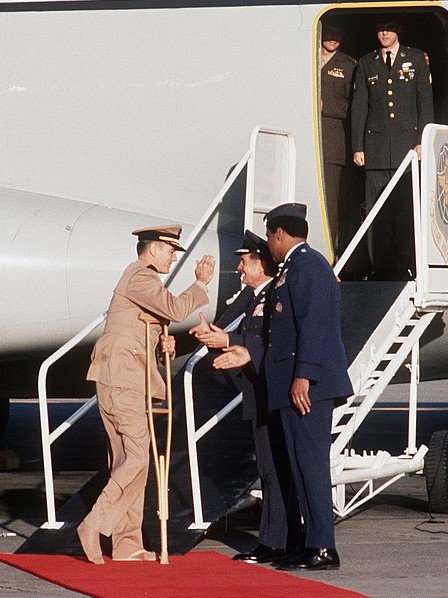
On February 12, 1973, Vohden arrived at Clark Air Force Base, Philippines, on the first plane bringing former POWs home. On arrival he was given the option to exit the back of the plane to which he responded, “I am going to meet the people just like the rest of you guys.” After negotiating the eight steps from the plane he set his crutches aside and saluted the awaiting Air Force general as the onlookers cheered. The photograph of his arrival appeared on the front pages of numerous newspapers across the country.
Submitted by CDR Roy A. Mosteller, USNR (Ret)
