
ENGINEER ON NC-4 THE FIRST AIRPLANE
TO FLY ACROSS ATLANTIC OCEAN
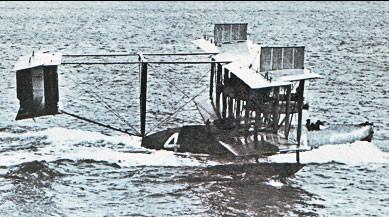
Curtis flying boat NC-4 was the first aircraft to fly across the Atlantic Ocean, albeit not non-stop. James Lawrence Breese Jr was one of two engineers among the six men aboard NC-4 for the historic flight. In 1919 the Navy sought to demonstrate that floatplanes were capable of transatlantic flight, thus four NC aircraft were built. NC-2 was cannibalized for parts leaving three to begin the journey on May 8, 1919, destination Lisbon, Portugal. Their route ran to Nova Scotia, proceeded to Newfoundland, then across the Atlantic via the Azores to Portugal, and ending in England. Along the route 53 Navy ships were positioned approximately every 50 miles like a string of pearls to assist in navigation and to rescue crewmen in case of an emergency.
Unfortunately, only several days into the flight NC-1 and NC-3 were forced to land at sea because poor visibility and loss of a visual horizon making flying extremely dangerous. NC-1 was damaged landing in the rough sea and was rescued by a Greek cargo ship which took NC-1 in tow, but NC-1 sank three days later and was lost. NC-3 succeeded in taxying some 200 miles to reach the Azores but was unable to fly again. Thus, on May 20, NC-4 departed Azores alone and after another stop because of mechanical difficulties, NC-4 finally reached Lisbon on May 27, becoming the first aircraft to fly across the Atlantic. On May 31, NC-4 flew to Plymouth, England, becoming the first aircraft to fly from the United States to Great Britain.
The complete trip for NC-4 was 3,936 nautical miles and took 23 days. Flight time was 57-hours 16-minutes as the maximum speed of NC-4 was 85MPH and service ceiling was 2,500 feet. Four engine NC-4 was plagued with problems during the trip. On the first leg of the flight one engine developed an oil leak and had to be shut down. Soon thereafter, a second engine suffered a failed connecting rod, so with only two functioning engines NC-4 was forced down at sea approximately 80 miles from a safe harbor to which the plane taxied. Here the broken engine was replaced. NC-4 was donated to the Smithsonian Institution but as it is too large to be housed in Washington, D.C., it is on permanent loan to the National Museum of Naval Aviation in Pensacola, Florida.
Readily available historical records reveal relatively little concerning James Lawrence Breese Jr. who was a Navy lieutenant at the time of the flight. He reportedly returned to civilian life soon after the flight and records reveal he was employed as a pilot for a firm working for Pan American Airways to determine transcontinental flight routes from Chicago to Los Angeles. During one flight Breese experience fuel problems and landed his twin engine plane in a cornfield near Santa Fe, New Mexico. He was so impressed with the area that in 1929 he moved his family from Lake Forest, Illinois, to Santa Fe where he remained for many years. While living in Santa Fe he built an oil burner business, reportedly developed 130 patents for home and military space heaters, designed the first thermostatically controlled heater for home furnaces, and became a well-known inventor. James Breese died of a heart attack at the age of 73 in San Diego, California, on April 1, 1959. He is buried at Southampton Cemetery in Suffolk County, New York.
Submitted by CDR Roy A. Mosteller, USNR (Ret)
