

ALLARD-ROBERT
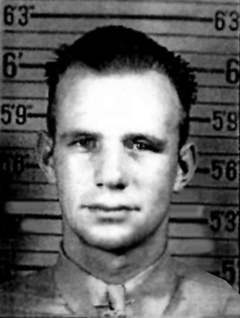
ROBERT VINCENT ALLARD

SGT

MAKIN ISLAND RAIDER BECAME WAR CRIME VICTIM
One of the first American offensive ground combat operations of World War II occurred on 17-18 August 1942, a Marine attack on Japanese forces on Makin Island in the Pacific. The aim was to destroy installations, take prisoners, gain intelligence and divert Japanese attention from the Allied landings on Guadalcanal and Tulagi. The force was drawn from the Second Raider Battalion and the plan was for the group, totaling 221 Marines, to embark aboard the submarines USS ARGONAUT and USS NAUTILUS and land from rubber boats powered by small 6hp outboard motors. Once in the objective area things began to go wrong as the submarines surfaced to discover rain, high winds and huge stormy seas. Despite the storm conditions a landing was ordered and shortly after midnight the raiders began their journey ashore. Shortly after 5AM the first group reached the beach in spite of the rough seas and the failure of many of the outboard motors. During the landing much ammunition and equipment was lost and due to communications difficulties a group of 13 Marines inadvertently landed behind enemy lines. While the main raider force awaited the signal to advance an accidental burst of gun fire alerted the Japanese and eliminated any hope of surprise. At 7AM the main group of raiders advanced from the beach and met strong resistance from Japanese snipers and machine guns which stalled the advance and inflicted casualties. The Japanese then launched two banzai charges that were wiped out by the raiders, killing most of the Japanese on the island, a fact unknown to the raiders. In the early afternoon twelve Japanese planes arrived, including two flying boats carrying reinforcements. As they attempted to land in the lagoon they were destroyed by gun fire from the raiders. The remaining planes bombed and strafed but inflicted no US casualties. During the day the natives on the island willingly assisted the Marines, carried ammunition and provided intelligence which suggested that enemy reinforcements had come ashore.
At 7:30PM the raiders began their planned withdraw using 18 rubber boats, many of which no longer had working outboard motors. Despite the very heavy surf seven boats with 93 men made it back to the waiting submarines. At 11:30 PM an attempt by another group of raiders failed to reach the submarines. Having lost most of their weapons and equipment, exhausted survivors struggled back to the beach to link with 20 armed men who had been left on the island to cover their withdrawal. The following morning several boatloads of raiders were able to fight the surf and reach the sub but 72 men with just three rubber boats were still on the island. On the morning of August 18 a rescue boat left the subs to stretch a rope ashore so the remaining raiders’ boats could be pulled out to sea but just as the operation began Japanese planes attacked sinking the rescue boat and forcing the subs to crash dive. Late that night raiders still on shore managed to signal the subs to meet them at the lagoon entrance and a raft of three rubber boats lashed to two native canoes and powered by two remaining outboard motors managed to bring exhausted raiders 4-miles to the mouth of the lagoon where they were able to board the subs. Due to conditions the Marines were unable to evacuate the bodies of their fallen comrades so natives were paid to bury them in a hidden common grave. Believing all the raiders had departed the island the group returned to Pearl Harbor where it was established that Marine casualties were 18 killed and 12 missing in action. Only after the war would the Marine Corp discover that nine of the missing Marines had been left alive on the island. With the assistance of natives the group evaded capture for a time but finally surrendered on August 30. The group was subsequently taken to Kwajalein Island where they were beheaded on October 16. In 1999 after several failed attempts and with the help of natives, the common grave on Makin Island of the Marines was finally located and they were returned home.
Sergeant Robert V. Allard is one of the 12 who were initially listed as missing in action. It has since been learned that on the morning of August 18, knowing that there were marines still on the island, the group commander asked for volunteers to take a rescue boat back return to the island. Although Allard had just survived the battle on the island and then the ordeal of making it to the submarines, he readily volunteered to return and was one of five strong swimmers chosen to return to the island. While the rescue boat was proceeding to the island Japanese planes were seen attacking and sinking it. It was assumed that all aboard were killed as no survivors were observed from the submarine. Unfortunately this was not the situation as Allard was one of the nine marines on the island who in the disorganized confusion of battle were left behind. According to translated Japanese documents the group was captured on August 24, on August 30 they were transferred to a ship and arrived on Kwajalein on September 2. After the war the Japanese claimed the captured marines received satisfactory care at the hands of their captors on Makin Island and humane treatment continued after they were moved to Kwajalein. This has been disputed by Kwajalein natives who reported the marines were subjected to harsh and cruel treatment. In early October a Japanese Vice Admiral advised there was no need to send the prisoners to Tokyo and a staff officer from a higher headquarters advised that a recently established policy permitted the disposal of the men as was seen fit. Accordingly, the Vice Admiral ordered the prisoners beheaded. The captives held no hopes for pardon or rescue as they walked blindfolded, one by one, to the spot of execution which also became their burial site. From testimony of a native who witnessed the execution and others, the Vice Admiral was tried after the war in a war crimes court and was convicted of atrocities for which he was hanged at Guam. The body of Sergeant Allard has never been recovered.
For his participation in the Makin Island raid, Sergeant Allard was awarded the Navy Cross. His citation was written before the actual circumstances of his death were known.
NAVY CROSS CITATION
The President of the United States of America takes pride in presenting the Navy Cross (Posthumously) to Sergeant Robert V. Allard, United States Marine Corp, for extraordinary heroism and conspicuous devotion to duty while service as a member of a volunteer boat crew in Company B, Second Marine Raider Battalion, during the Marine Raider Expedition against the Japanese held island of Makin in the Gilbert Islands on 17 and 18 August 1942. Fully aware of the hazards of an imminent enemy air attack, and with complete disregard for his own life, Sergeant Allard, with four others, volunteered to take a boat to a point just outside a reef and shoot a line ashore to assist in evacuating those men remaining on the beach. Caught on the sea, he was defeated in his valiant efforts by the violent strafing of his boat by withering enemy machine gun fire. His great personal valor and loyal spirit of self-sacrifice were in keeping with the finest traditions of the United States Naval Service. He gallantly gave up his life in the service of his country.
Submitted by CDR Roy A. Mosteller, USNR (Ret)