

BILLEY-WILFRED
WILFRED E. BILLEY
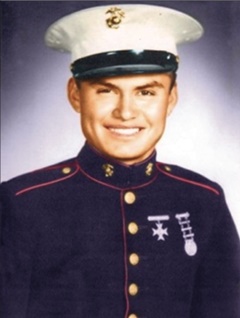
CPL

NAVAJO CODE TALKER
Born on December 28, 1922, Wilfred E. Billey, a Native American Navajo Indian, was raised by his grandparents and lived a simple life. They spent their summers in the Chuska Mountains above Sanostee, New Mexico, herding sheep and farming. The family lived in a traditional forked stick hogan. Billey attended Toadlena Boarding School and was taken to school on horseback by his grandfather. For junior high he attended school at Shiprock. In 1941, Billey was enrolled at Navajo Methodist Mission School in Farmington, a boarding school for young Navajos. One day in 1943 the school superintendent informed students that the Marine Corps was looking for a few good men fluent in Navajo and English. He asked for volunteers and Billey stepped forward. He later said it was because he wanted to stay with his buddies who also volunteered. The young recruits were sent to Camp Elliot in San Diego to undergo 13-weeks of basic training. The Navajos were then trained as radiomen and became Navajo Code Talkers.
Billey was sent to the 2nd Marine Division at Wellington, New Zealand, where they practiced amphibious landings in preparation for the battles to come. On November 20, 1943, the marines invaded the island of Tarawa where for the first time in the war marines faced serious Japanese opposition to an amphibious landing. Tarawa was of one of the bloodiest battles in the Pacific Theater as about 25% of the marines suffered casualties in the short time of only 76 hours. Billey would later say he never saw so many dead men. On June 15, 1944, the 2nd Marine Division invaded Saipan in the Mariana Islands. Billey and his communications group made it to the jungle and radioed U.S. ships to direct fire upon enemy locations. Billey later fought on the islands of Tinian and Okinawa.
Billey was discharged as a corporal in 1946, finished high school and earned bachelors and master's degrees from New Mexico Highlands University in Las Vegas, New Mexico. He worked over 40 years in the schools at Shiprock, New Mexico, as a teacher, an Indian Education director, and a principal. He also served as a counselor - all in northwestern New Mexico. Billey was honored with a Doctorate of Humane Letters from the College of Santa Fe, New Mexico. In the latter part of his life he spent his time ranching, farming, fighting for his tribe's water rights and sharing the story of the Code Talkers.
Billey died on December 12, 2013. The President of the Navajo Nation's Shiprock Chapter recalled spending time in Billey's office when Billey was a counselor at Shiprock High School in the late 1960s. "He was a great man, he had a tremendous, positive influence on many of us. He said we needed to recognize the hardship that many of our families experienced and a sure way to get out of that hardship is education." Billey gained the respect of students with a sense of calmness and kindness, said a human resources coordinator at Central Consolidated School District. When he spoke about being a Code Talker, Billey never focused on himself. "It was always about the work, the people he worked with and what it meant to him and to the other men who had done the same thing as him. Just the pride in their country and the pride in what they had done."
The Navajo Code Talkers were such a success during World War II that the Japanese never succeeded in breaking their code. As a result, when the Code Talkers were discharged they were cautioned not to discuss the program. Billey honored the request, did not discuss the details of his war time service and not until the program was declassified did he feel free to tell family and friends what he had done. Billey’s daughter said her father would recall his experiences during World War II with humility and said, “I’m not a hero. The heroes are the ones we left behind.” In 2001 the Congressional Silver Medal was awarded to Billey and his companion Code Talkers. Billey worked with New Mexico's congressional delegation to decide on the words appearing along the bottom of the medals: "Dine Bizaad Yee Atah Naayee' Yik'eh Deesdlii" or "The Navajo language was used to defeat the enemy.”
Submitted by CDR Roy A. Mosteller, USNR (Ret)