

DOWNEY-CHARLES
CHARLES STANLEY "CHUCK" DOWNEY
CAPT

A Toast to Capt. Chuck S. Downey
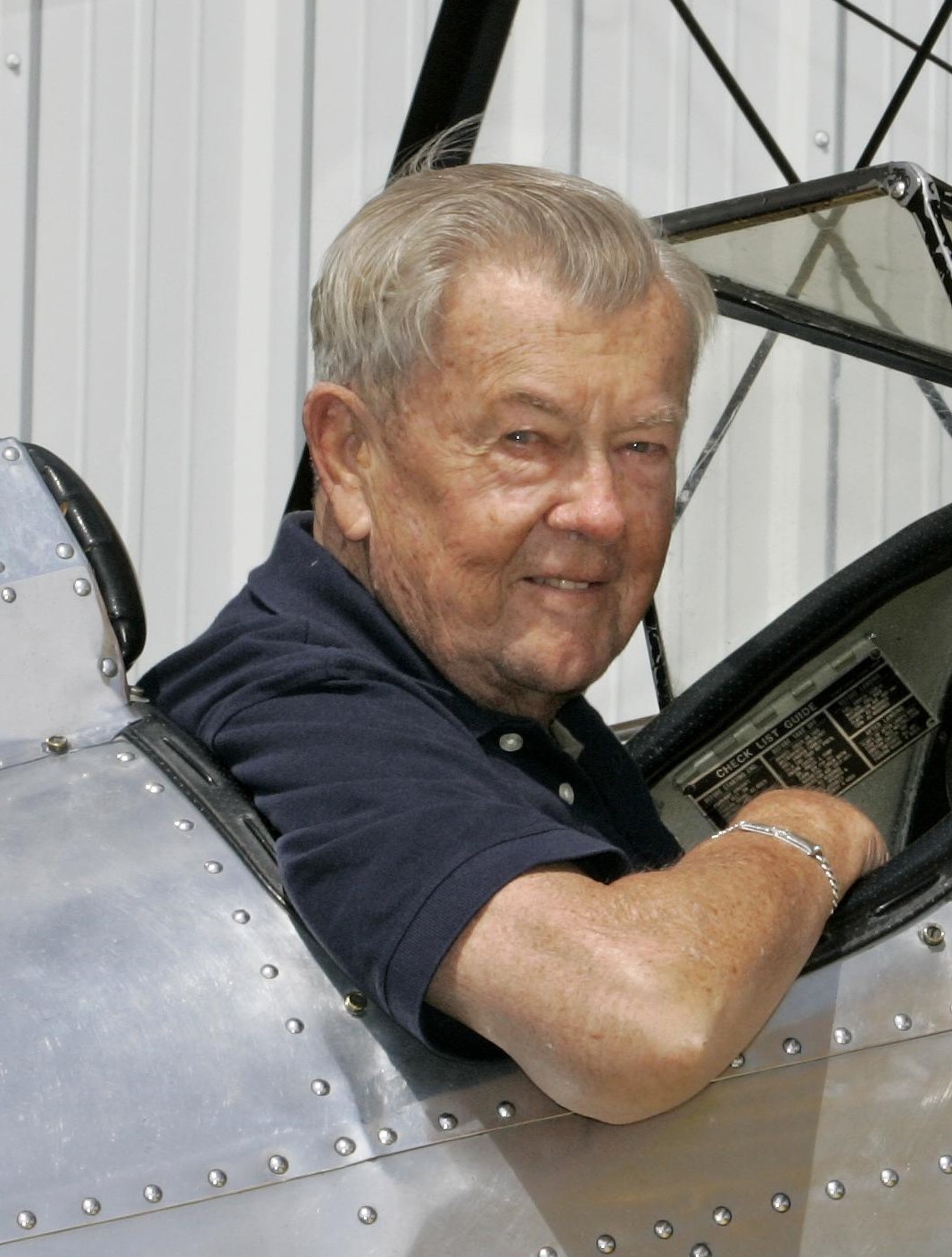
Charles S. Downey was born August 2, 1924 in Bridgeport, Conn. His love affair with aviation began almost immediately. At age three he remembers Lindbergh’s dramatic flight. Chuck picks up the story:
“I vividly recall the family dining room where my parents and their friends held vigil, sipping homemade elderberry wine, ears tuned to the staticky, smelly, battery [powered] Atwater-Kent radio, waiting and waiting for news of the famous flyer. For me, at age 3... the excitement was as great as that of the adults.”
At age 7 Chuck was enthralled by the Sikorsky Flying Boats that regularly flew over their summer cottage on their way to and from the nearby factory at Stratford.
By age 13 he was making flying models and by 16 had won several trophies as a champion junior model builder.
His first flight came in 1934.
“Though not qualified for OX-5 membership by current rules,” Chuck says, “my first flight in 1934, against my father’s wish, but huddled against mother in a cold, drafty front cockpit, circling Hartford, Conn. out of Brainard Field [was] in an OX-5 powered Waco 10.”
“My aviation love affair continued, as did the gathering winds of war, resulting in the early wedding, at age 18, with Naval Aviation and a glorious honeymoon in the N2S Stearman, SNV Vultee Vibrator, SNJ Texan, SBC Curtis Helldiver (two winger version), BT Northrup Dive Bomber, OS2U Kingfisher Scout, SB2C Helldiver (one winger), F4U Corsair, F6F Hellcat, TBM Avenger, AM-1 Mauler, AD-4 Sky Raider, F9f Cougar jet, T-34 Mentor, SNB Bugsmasher, C-54 Skymaster, P2V Neptune and S2F Tracker.
“There were many exciting moments flying the various aircraft listed, especially operating against the Japanese in the Western Pacific from the Attack Carriers Ticonderoga and Hancock. Dive bombing strikes were only considered easy when you caught the #2 wire and unwound in the ready room sipping Old Overholt (WW2 approved medicinal booze).”
Let’s stop right there and pick up on a few things. Chuck entered the Navy in October, 1942. He did his initial training in Memphis, Tn., then to Pensacola, Fl. When Chuck was commissioned as Ensign AV-N serial number 291132 on July 16, 1943 at NAS Pensacola, he was 18 years, 11 months and 14 days. This made him the youngest Naval aviator in the U.S. Navy during WW2.
Then it was off to Glenview in September of ’43 for carrier qualifications.
The Navy had built two makeshift carriers out of two coal burning sidewheeler luxury excursion ships. They were named the Wolverine and the Sable. They were only used for carrier landing qualification as they plied the waters of Lake Michigan.
The decks were only 550 feet long, or about 2/3 the length of the real thing, and the ships could only make about 20 knots. Unless there was a stiff wind blowing to aid the approaches and the take-offs, training stopped. They were also only 27 feet above the water as opposed to 80 feet for an attack carrier. Today there are over 150 Navy aircraft at the bottom of Lake Michigan as a testament to the intensity and difficulty of the training.
On his first trip from Glenview, out to the Sable, for his first landing, he was leading a flight. He knew, as leader, it would look pretty bad if he couldn’t find the ship. He found it OK but it looked like a postage stamp. Then he thought “You mean I have to land on that thing.” He did, he qualified and his combat career was about to begin.
He saw combat duty on both the U.S.S. Ticonderoga and the U.S.S. Hancock flying the SB2C Helldiver. The Helldiver was an airplane that was so big and, some say so ugly, that it was known as The Beast. But this 18 year old from Bridgeport could fly it.
On 13 November, 1944, at Manila Bay, Downey helped sink a Japanese light Cruiser. In the course of that action, his plane was hit by shrapnel from the explosion of the bomb from his flight leader. The damage nearly ended the mission but Chuck was able to get the plane back to a carrier. He was awarded the Distinguished Flying Cross for this action.
On January 21, 1945, the Ticonderoga was hit by two kamikaze suicide planes which took the ship out of action. Chuck was on board during both attacks. To this day he has parts of one of the kamikaze airplanes as well as part of the uniform from one of the pilots. A few days after the attacks, Chuck’s air group was transferred to the Hancock.
On 17 February, 1945 his air group was the first to bomb the Japanese mainland. He was awarded an Air Medal for destroying hangars and repair buildings at a Japanese airfield.
After the war Chuck stayed with the Navy Reserve and, in 1947, was recalled to serve. In 1950 he transitioned to the F9F Panther jet and commissioned a LtJG. He participated in the first full-scale submarine launched missile exercise.
On August 25, 1951, he married his wife, Lorna.
He was assigned to the U.S.S. Intrepid as part of the task force in charge of the Hunter/Killer Force – Atlantic Fleet.
In 1952 he was now working for American Airlines which transferred him to Chicago where he joined the Attack Squadron 722 at NAS Glenview.
In 1954 he was appointed Ops Officer for the squadron and commissioned a LCDR. He qualified in swept wing jets in 1956, and was then appointed Exec. Off. for the squadron.
In 1957 he was appointed the Squadron CO. the mission of Squadron 722 changed from jet Attack to Anti-Submarine Warfare.
In 1958 he was commissioned a CDR....at age 33.
He had taken Squadron, now VS 721 through new aircraft transition and had created a comprehensive training program. In ’59 VS721 participated with the Pacific Fleet in the first full scale joint exercise employing Reserve Units called “Operation Skynet”. His Squadron appraisal rating given by the Navy was “Excellent”.
By 1960 he had completed a three year term as CO of ASW SQ. VS-721 and was appointed Assistant Commander – Air Wing 72 having responsibilities for logistics, administration and anti-sub warfare training. He developed the Operational Control Center for tactical management for ASW forces.
Chuck also purchased Meyers OTW serial #40 this same year. Chuck named it “Fly Navy”.
He attended the Naval War College in 1961, completing a senior global strategy course and later participated in the Chief of Naval Operations Commanded Orientation Program at the Pentagon.
In ’63 he completed his 3 year term as Ass. Commander of air wing 72 and was appointed Instrument Instructor for VS 724. Also, in 1963 he was selected for Captain at age 39 and became the youngest Captain in the Navy at that time. He served as a wing commander for three years and retired from the Navy as a Captain in 1975....at age 51. In civilian life, he was an aviation executive, having worked for American Airlines, Commuter Airlines, Butler Aviation and Midway Airlines.
At American he was Director of Facilities, responsible for design, development, construction and maintenance of essential facilities supporting large transport aircraft from 1966 to 1968.
At Commuter Airlines, Inc. he was Vice President of Operations, responsible for all flight, maintenance and operations functions of the airline providing daily turbo-prop service between Chicago and other Midwestern cities from 1968 to 1970.
From 1970 to 1975 he was Vice President of Butler Aviation responsible for all aviation servicing operations performed by the company at O’Hare, Midway, Meigs, Detroit Metro and Willow Run airports.
He was a consultant to Midway Airlines from 1976 to 1978 and became Vice President of the airline in 1979. He held that position until resigning in 1981 at which time he joined the Centurion Petroleum Corporation.
Now I couldn’t find much information on what he did at Centurion but my guess is, with the price of gas, he wishes he were still there!!
As you can see, aviation has been a big part of Capt. Downey’s life. He played a major role and contributed greatly to United State Navy airpower. He would tell you he was just doing his job, but what a job it was. He served this country in both war and in peace. He has logged over 8,000 hours in 22 different military aircraft and 23 different civilian aircraft. He has made contributions to aviation with every take-off and with every job.
But, there is another side of Captain Downey. He’s a family man. As I said, he married Lorna in 1951. They had four children:
Christie, who married Mike Sandusky Karen, who married Dick Lunceford Elaine, married Andy Steinbeck Martha married Bob Foster and Charlie married Sheila. The grandkids are: Sarah and Carl Sandusky Anna Lunceford Jenna and Keiten Steinbeck Kevin and Collen Foster and Emma Downey.
Unfortunately, the love of Chuck’s life, his wife Lorna, passed away a few years ago and, in fact, we almost lost Chuck last year. It was a close call for Chuck. But, lots of prayers, some good doctors and that ol’ Navy spirit pulled him through. As he would say, “I just wasn’t ready to leave the planet.”
Finally, Chuck has more friends in high places, and maybe a few in low places, than could ever be counted. But a few sent along a few words of...well...stories and lies I guess.
Last June 15, as I was leaving his house carrying a lifetime of pictures in his briefcase, Chuck admonished me to not make a big deal out of this presentation. In his words, “Don’t get carried away with this. I’ve taken a lot of salutes.”
It’s been a challenge to walk the line between not getting carried away and somehow showing the deep respect and honor I have for him to just be in the same room with him....or to use his words “on the same planet with him.”
There are no words or actions that would help me describe my love and honor for this man. We have talked about many things from airplanes to theology.
His guidance, wisdom, sense of humor and devotion to family, country and friends has defined him throughout his life, in whatever he has done.
I am both honored and humbled to be able to call him a dear friend, and count it a blessing that our paths have crossed.
So now, it is a most unique honor to be able to toast this man of courage, of principle and of devotion to God, family and country....ladies and gentlemen, will you please take your drink in hand and rise to join me in a toast.
To a man that has done so much to preserve the freedoms of our country, To a man that has enriched the lives of so many people through aviation, And to a man that has been a loving husband, father, grandfather and friend. May God continue to bless Captain Charles S. Downey with good health, good life, fair skies and following seas.