

FAIR-CHARLES
CHARLES EDISON FAIR
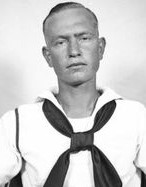
AOM3

LOST AT SEA - BATTLE OF MIDWAY - 6/4/1942
Air power was a novelty in World War I, but this changed in 1937 during the Spanish Civil War when Germany destroyed a town in Spain from the air. During World War II air power became increasingly important and when the Battle of Midway was fought in June 1942, air power demonstrated itself as a dominant power. Four Japanese carriers were sunk, the Japanese never fully recovered from their devastating losses, and historians have called it “the most stunning and decisive blow in the history of naval warfare.”
On the early morning of June 4, 1942, Aviation Ordnanceman Third Class Charles Edison Fair was the machine gunner of a TBF-1 Grumman Avenger torpedo bomber that departed Midway Island in a flight of six TBFs of Torpedo Squadron Eight, assigned to the carrier USS Hornet. Intelligence reported that a Japanese fleet was approaching to attack Midway. The TBFs were without fighter protection as the TBFs headed in a slightly different direction than the main body of aircraft that had departed from carriers off Midway in search for the Japanese fleet and all the fighters accompanied the main body of U.S. aircraft.
The TBF flight was the first to sight the Japanese fleet and although alone the TBF flight commenced an attack. As they approached the Japanese, a large swarm of Japanese fighters systematically began withering fire destroying the attacking TBFs one by one as they crashed into the sea. Although facing an overwhelming number of Japanese fighters, the TBFs continued their attack and five of the TBFs were quickly destroyed. Only one TBF survived the devastating attack and was able to eventually return to safety. Unfortunately, AOM3 Fair and his two crewmates were killed during the attack. As the TBFs were the first U.S. elements to engage the Japanese, AOM3 Fair and his crewmates were among the first casualties in the Battle of Midway.
Charles Edison Fair was born May 24, 1919, in Whitesboro, Texas. His mother died in 1924 when Charles was only five and his father remarried. Unfortunately, his father died in 1936 when Charles was seventeen, leaving his stepmother to raise him. On January 7, 1937, Charles joined the U.S. Army and served until honorable discharged on September 7, 1939, from Battery B, 82nd Field Artillery at Fort Bliss, Texas. On October 9, 1939, Charles enlisted in the Navy at El Paso, Texas. Following recruit training at San Diego he was assigned duty on December 12, 1939, to Naval Air Station, San Diego. On October 19, 1940, he was reassigned to the destroyer tender USS Altair. On October 18, 1941, he was next assigned to Torpedo Squadron Eight aboard the new carrier USS Hornet.
When the ship left the East Coast to join the fleet in the Pacific, AOM3 Fair remained in Norfolk with other crewmembers to accept delivery of twenty-one new Grumman TFB-1 torpedo planes from the factory. The TBFs were later flown to the Naval Air Station, Kaneohe Bay, Hawaii, arriving there on May 20, 1942. When a decision was made to fly six of the TBFs to Midway Island to augment the island’s defenses, AOM3 Fair was a crew member of one of the TBFs.
As the remains of Aviation Ordnanceman Third Class Charles Edison Fair were never recovered his name is inscribed in the Courts of the Missing at the National Memorial Cemetery of the Pacific in Honolulu, Hawaii. Following the battle, the Navy awarded the Distinguished Flying Cross to all enlisted aircrew members who died during the battle. It has been reported that during the battle Torpedo Squadron Eight lost forty-five of the forty-eight aircrew and twenty of the twenty-one planes that flew against the Japanese fleet. Torpedo Squadron Eight became the war’s most decorated naval air squadron while suffering the heaviest losses in U.S. naval aviation history.
DISTINGUISHED FLYING CROSS CITATION
The President of the United States of America takes pleasure in presenting the Distinguished Flying Cross (Posthumously) to Aviation Ordnanceman Third Class Charles Edison Fair, United States Navy, for extraordinary achievement while participating in aerial flight as free machine gunner of a Torpedo Plane in action against enemy Japanese forces in the Battle of Midway, 4 and 5 June 1942. In the initial attack upon an enemy aircraft carrier, Seaman First Class Pitt, with utter disregard for his own personal safety, effectively manned his machine gun in the face of a tremendous barrage of fire from numerous Japanese fighter planes and anti-aircraft batteries. His courageous determination and devotion to duty were in keeping with the highest traditions of the United States Naval Service.
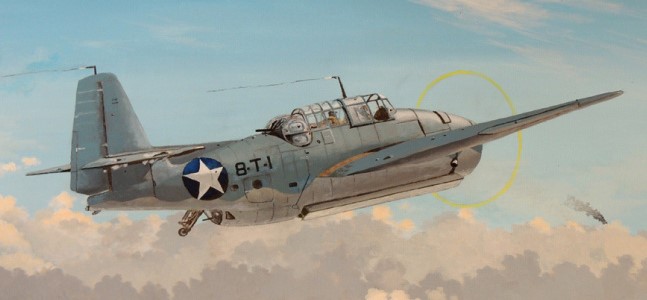
TBF-1 OF VT-8 IN FLIGHT
Submitted by CDR Roy A. Mosteller, USNR (Ret)