

GILMER-JOHN
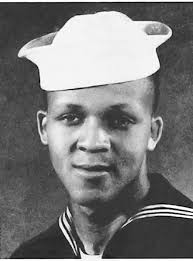
JOHN SAMUEL GILMER
MUS3 / SSGT

HELPED TO DESEGREGATE THE NAVY DURING WORLD WAR II
Music has a long tradition within the U.S. military dating back to the American Revolutionary War. During the early days of World War II music played a role for some service members, helping to open the door to desegregation in the Navy. These history making musicians were the 45 members of the all-black B-1 Band, organized during May 1942 in Greensboro, North Carolina, the first African Americans to achieve a rate other than messman in the modern Navy. Following World War I the Navy refused to admit African Americans until 1937 but even then the only opportunities open to African Americans were menial positions in galley service. President Roosevelt attempted to nudge the Navy toward integration in June 1941 by suggestion the placement of “good Negro bands” aboard battleships but it was not until World War II began that his suggestion materialized with the plan to place black bands at several preflight schools. In early 1942 the Navy sent a recruiter to A&T College of North Carolina in Greensboro which boasted one of the best black college bands in the nation. The recruiter promised to form a 45-piece Navy band composed of black musicians and on May 27, 1942, he successfully recruited 23 members of the A&T band who were sworn into the Navy and formed the nucleus of the B-1 Band. Following recruit training at Norfolk the men were sent to the University of North Carolina in Chapel Hill where the band played for the raising of colors every morning, playing as the sailors marched between classes, military reviews, local war bonds rallies, and other formal military functions. In May 1944 the B-1 Band was transferred to Pearl Harbor where they were the largest Navy band in the Pacific, the largest posting of African Americans in the Navy, became known as the “Admiral’s Band,” and were the star of the V-J parade in Honolulu when the war ended.
John S. Gilmer was born on March 14, 1925, in Greensboro, the only child in his family. When the Navy recruiter came to Greensboro, Gilmer was a student at Dudley High School and was one of 9 students from the high school who joined the Navy on May 27, 1942, all becoming one of the initial members of the B-1 Band. He spent his entire Navy career with the B-1 Band in North Carolina and Hawaii, and when released from active duty he majored in music at A&T College of North Carolina. After college he enlisted in the U.S. Army and served with the famed “triple nickel battalion” of paratroopers, the all black 555th Parachute Infantry Battalion. Gilmer retired from the Army with 21 years of military service following which he worked for the U.S. Postal Service and as a restaurant manager at Trailways Bus Line. He died on January 1, 2014, and was buried with full military honors at the Fort Mitchell National Cemetery in Mitchell, Alabama.
Although many reports have been written that other African Americans were the first to achieve assignments in the Navy in other than galley work, historians have substantiated that records establish that the original members of the all black B-1 Band are indeed the recipients of this honored distinction. Although there were more than 100 African American bands in the Navy during World War II, the B-1 Band was the first and has been widely credited with being a major influence in the acceptance of African Americans into all branches of the Navy. As one B-1 Band member has said, “The next step wouldn’t have happened without the first step. We played with pride. We did our best everywhere we went.”
Submitted by CDR Roy A. Mosteller, USNR (Ret)