

OXENDINE-THOMAS
THOMAS OXENDINE
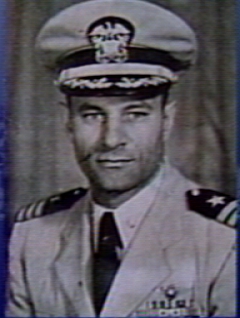
CDR

FIRST AMERICAN INDIAN NAVAL AVIATOR
Thomas Oxendine grew up a Lumbee Indian in Pembroke, North Carolina, where he was born on December 23, 1922. When he was a boy there were three school systems in Pembroke, one for white children, a second for African-American and a third for Indians, which Oxendine attended. He did well in school graduating at the age of 15 in 1938 from Cherokee Indian Normal High School. He then attended Pembroke State College, now the University of North Carolina at Pembroke. While in school he was a star in three sports at both the high school and college levels. As a boy he joined a small group of Native Americans who were recruited to become pilots and earned his pilot’s license. When World War II broke out he immediately tried to enlist in the Navy but the Navy’s segregation rules delayed his enlistment until Washington permitted him to join the Naval Air Corps program in February 1942. In December 1942 he complete flight training, was commissioned an Ensign and was widely acclaimed as the nation’s first American Indian Naval Aviator. His first duty assignment was as a scout observation pilot of a OS2U Kingfisher float plane aboard USS MOBILE (CL-63) where he served about two years and took part in 33 battles.
On July 26, 1944, during adverse weather, Oxendine engaged in action against the Japanese at Yap Island in the Caroline Islands. Yap was one of the islands bypassed in the U.S. island hopping strategy although it was regularly bombed by U.S. ships and aircraft. In a 1974 interview Oxendine said that during the Yap action a TBM bomber was shot down very close to the beach where it was too shallow for a rescue submarine to reach the downed airmen. He said he was initially radioed to try a rescue of the men but as he proceeded to do so he was told to not land as it was considered too dangerous. Oxendine continued that he elected to overrule the order as he could clearly see the men in the water so he landed and zigzagged at high speed on the surface to them. Although fighter planes were strafing the beach, bullets from the Japanese were striking his plane and the water all around him. When he reached the two men they were able to climb onto the wing and he again zigzagged at high speed on the surface until out of range of the gunfire. The men then managed to get into the plane’s back seat, they took off and flew back to USS MOBILE. For his heroic actions Oxendine was awarded the Distinguished Flying Cross. Following his duty aboard USS MOBILE he transitioned into fighters and flew the F6F Hellcat and F4U Corsair.
Oxendine was released from active duty in 1947, returned to Pembroke State College to complete his education and was employed as athletic director and coach at Pembroke from 1950 to April 1951. During the Korean War he was recalled to active duty and transitioned into jet fighters in various squadrons from 1951 to 1960. His assignments included being a test pilot and also a combat flight instructor in the F8V Crusader. Other assignments included as Commanding Officer of Training Squadron Two in the Naval Basic Training Command (Jan 1960 to November 1962) and assignment as Deputy Fleet Information Officer on the staff of Commander-in-Chief U.S. Pacific Fleet (November 1962 to July 1965). He was next assigned to the Office of Information in the Pentagon (1965 to 1968) followed by assignment as Public Affairs Officer for Naval Air Systems Command. Upon his retirement in June 1970 he became the Public Information Officer for the Bureau of Indian Affairs in Washington, D.C., where he remained for 16 years. CDR Oxendine died on May 27, 2010, and on Memorial Day, May 31, 2010, was laid to rest at Sandcutt Cemetery in Pembroke, North Carolina.
Submitted by CDR Roy A. Mosteller, USNR (Ret)