

CLARK-JOSEPH
JOSEPH JAMES "JOCKO" CLARK
ADM

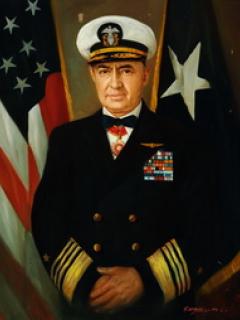
First Native American Graduate of U.S. Naval Academy
Joseph James Clark was born on November 12, 1893, in Pryor, Oklahoma, son of Cherokee Indian William A. Clark and Lillie Berry Clark. He attended Willie Halsell College, Vinita, Oklahoma, and the Oklahoma Agricultural and Mechanical College, at Stillwater, before entering the U.S. Naval Academy from which he graduated in June 1917 with the Class of 1918. He was the first Native American graduate of the Naval Academy. During World War I he served in the cruiser USS NORTH CAROLINA engaged in convoying troops across the Atlantic. Following the war he remained at sea serving in the destroyers USS AARON WARD, USS AULICK and USS BROOKS in the Near East, later commanding the USS BROOKS upon return to the United States. From 1923 to 1924 he was an instructor at the Naval Academy. On March 6, 1925, he was designated a Naval Aviator and served with Aircraft Squadrons, Battle Fleet, successfully as Flight Officer of Utility Squadron ONE, Aviation Officer of the battleship USS MISSISSIPPI and Aviation Technical Advisor to Commander Battleship Division THREE. He commanded Fighting Squadron 2-B on USS LEXINGTON in 1931-32, and was Air Officer of that carrier in 1936-37. Shore duty on regular rotation during the period between wars included tours as Executive Officer of the Naval Air Station, Anacostia, DC; as Aeronautical Member of the Board of Inspection and Survey, Navy Department; as Executive Officer of the Fleet Air Base, Naval Air Station, Pearl Harbor, T.H., with additional duty in command of Patrol Wing TWO, 1938-39; as Inspector of Naval Aircraft, Curtiss-Wright Corporation, Buffalo, New York, 1940; and as Executive Officer of the Naval Air Station, Jacksonville, Florida, 1940-41.
Clark was aboard the carrier USS YORKTOWN when the United States entered World War II and participated in the raids on the Marcus and Gilbert Islands. He commissioned the escort carrier USS SUWANEE and was in commanded during the assault and occupation of French Morocco in November 1942. For this service he received a Letter of Commendation. He commanded the carrier USS YORKTOWN (fourth vessel of that name) from her commissioning in April 1943 to February 1944, in operations against Marcus, Wake, Mille, Jaluit, Makin, Kwajalein and Wotje, and for conspicuous gallantry was awarded the Silver Star Medal. In the rank of Rear Admiral he was a Task Group Commander of carriers and screening vessels operating alternately with the FIRST and SECOND Carrier Task Groups of the Pacific Fleet, and for distinguished service (including Okinawa, Ryukyus and the Tokyo area), was awarded the Distinguished Service Medal (two awards), the Navy Cross, and Legion of Merit with Combat "V". Upon his return to the United States in June 1945, he was appointed Chief, Naval Air Intermediate Training Command, Corpus Christi, Texas. In September 1946 he became Assistant Chief of Naval Operations for Air, and from November 1948 had duty afloat in command of Carrier Division FOUR and Carrier Division THREE, with a tour in the interim, August 1950 - October 1951, as Commander Naval Air Bases, Eleventh and Twelfth Naval Districts. On March 24, 1952, he was designated Commander FIRST Fleet, in the rank of Vice Admiral, and on May 20, 1952 transferred to command of the SEVENTH Fleet. He was transferred on December 1, 1953, to the Retired List of the U.S. Navy and was advanced to the rank of Admiral on the basis of combat citations.
After retirement, Admiral Clark was a executive as Chairman of the Board of a New York investment firm. Clark was an honorary chief by both the Sioux and Cherokee nations. He died July 13,1971, at the Naval Hospital, St. Albans, New York, and is buried in Arlington National Cemetery.
Decorations included: Navy Cross, Distinguished Service Medal (two awards), Army Distinguished Service Medal for service in Korea, Silver Star Medal, Legion of Merit with Comabt "V", Commendation Ribbon with Combat "V," Army Commendation Ribbon, and Ribbon with stars for the Presidential Unit Citations to the USS SUWANEE, USS YORKTOWN, and USS HORNET. Victory Medals for World War I and II; American Defense Service Medal; European-African-Middle Eastern (one star), and Asiatic-Pacific(twelve engagements) Campaign Medals; and the Philippine Liberation Ribbon (one star). Also, Navy Occupation Service Medal, Korean Service Medal (one star), United Nations Service Medal; and the National Defense Service Medal.
Submitted by CDR Roy A. Mosteller, USNR (Ret)