

STANDISH-WALTER
WALTER STANDISH
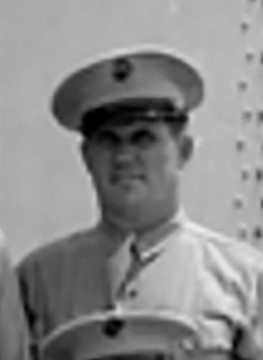

GYSGT

LOST AT SEA
Wladyslaw Stankovitch was reportedly born on July 17, 1901, in Vilna, Russia, and in 1912 emigrated to the United States where he settled in Boston, Massachusetts. In 1919 he enlisted in the Marine Corps and completed basic training at Parris Island. Because of his previous civilian occupation as a meat cutter, he was often assigned duties as a mess attendant. In 1928, he was promoted to the rank of Sergeant and changed his name to the more American-sounding “Walter Standish”. SGT Standish qualified as an Expert Rifleman and was chosen for the Marine Rifle and Pistol Team in 1937. He also was an instructor at the San Diego Rifle Range and made Gunnery Sergeant in 1939. He reported to the USS HOUSTON for sea duty in August 1940.
By the afternoon of February 28, 1942, HOUSTON and its crew had been through a lot. Its rear turret had been rendered useless on February 26 during the Battle of the Java Sea by a Japanese bomb which had killed a number of crewmembers and much of HOUSTON’s ammunition had been found to be defective. Only HOUSTON and the Australian heavy cruiser HMAS PERTH remained in the Java area fit for duty and the crew worried about their chances against the anticipated arrival of a numerically superior Japanese force reportedly bound for an invasion of Java. HOUSTON and PERTH were ordered to attempt to escape to Australia through the Sunda Strait under cover of darkness. The two ships set out on February 28 to clear Sunda Strait at dark with PERTH in the lead. Just before midnight, PERTH detected a nearby ship which was identified as a Japanese destroyer and engaged it in battle. Unfortunately, PERTH and HOUSTON had sailed undetected into the midst of the Japanese invasion fleet and found themselves vastly outgunned by the ships that surrounded them. The two ships chose to engage the Japanese in an attempt to sink as many of the enemy transports as possible. During the fierce Battle of Sunda Strait which ended just after midnight, the two Allied cruisers were both sunk.
After PERTH had been sunk and it became obvious that HOUSTON was mortally wounded and sinking, the commanding officer gave the “Abandon Ship” order as the ship lost headway and began to seriously list. As crewmembers slipped over the side, Japanese ships moved closer to HOUSTON and used searchlights to enable their gunners to target the escaping HOUSTON crew. Machine guns aboard HOUSTON were manned by Marines and as they shot out searchlights, there seemed always to be another to take its place. One of the Marine gunners later said that he thought he had been firing for nearly an hour when his gun stopped for lack of ammunition. GYSGT Standish was the NCO in charge of the machine guns mounted on the forward mast and manned by Marines. As his shipmates were going over the side, a senior officer told Standish to also leave but Standish turned to a marine and reportedly said, “Better go, Charlie -- it’s all over -- finished.” Asked if Standish was also going he replied, “I’ll never make it. Go now and swim away before you’re pulled under. Goodby, Charlie.”
Of the 1,061 crewmembers aboard HOUSTON, 368 reportedly survived the ship’s sinking only to be captured by the Japanese and interned in prison camps. Following the end of the war, several survivors reported that as HOUSTON sank, GYSGT Standish was clearly observed as he remained at his post continuing to fire his machine gun at the Japanese and that his firing ceased only as HOUSTON’s fore mast slipped beneath the surface. His body was never recovered and he was official declared dead on December 15, 1945. The name of GYSGT Walter Standish is inscribed on the Tablets of the Missing at the American Cemetery and Memorial in Manila, Philippines. He was survived by his wife who was living in San Diego, California.
Submitted by CDR Roy A. Mosteller, USNR (Ret)