

CADLE-JOHN
JOHN WILSON CADLE JR
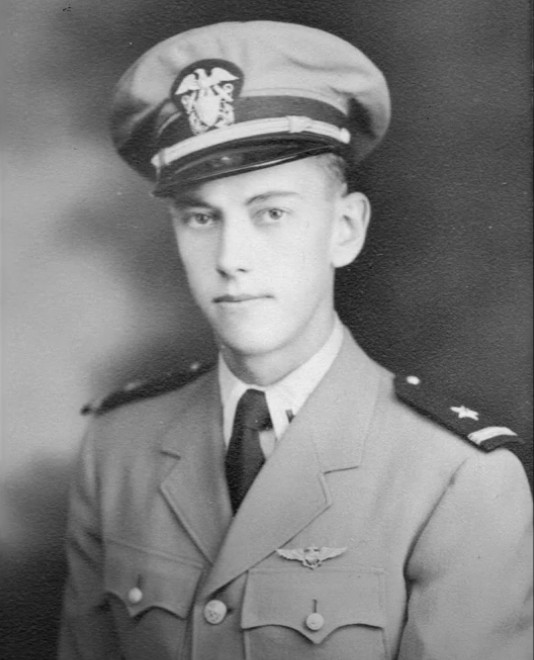
CDR
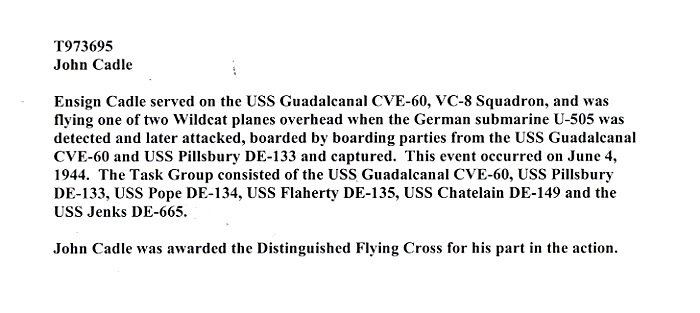
HE HELPED TO CAPTURE A GERMAN U-BOAT
On June 4, 1944, an order not heard aboard a U.S. Navy ship in over 100-years was sounded - Away all boarding parties. Thus began an event which culminated in the boarding and capture by the Navy of a foreign man-of-war during battle which had not occurred since 1815. This was the capture of the sinking German submarine U-505 approximately 150-miles off the west coast of Africa by antisubmarine hunter-killer Task Group 22.3. The event was unprecedented and kept secret from Germany and the U.S. public for almost a year until the close of World War II against Germany.
Task Group 22.3 sailed from Norfolk, Virginia, on May 15, 1944, on its third mission with five destroyer escorts screening the escort aircraft carrier USS GUADALCANAL (CVE-60). During its first two forays in January and April, Task Group 22.3 had badly damaged one German U-boat and sunk three others. CAPT Daniel V. Gallery, the task group commander aboard GUADALCANAL formed an audacious plan to force a damaged German U-boat to the surface, force its crew overboard, and then board and capture it before it sank. On May 17, 1944, CAPT Gallery sent the following message to his escort ships: EACH ESCORT DRAW UP PLANS AND ORGANIZE A PARTY TO BOARD-CAPTURE AND TAKE SUB IN TOW IF OPPORTUNITY ARISES. CAPT Gallery later exclaimed, The plan worked to perfection!
Until the bright and sunny morning of Sunday, June 4, 1944, the passage of Task Group 22.3 had been uneventful and with fuel running low CAPT Gallery had ordered them to make for Casablanca to refuel. At 1109 one of the escorts reported, WE ARE INVESTIGATING POSSIBLE SOUND CONTACT. At 1112, the escort signaled her confirmation of the contact as a submarine and fired a full pattern of hedgehogs at the submerged contact. The contact-detonated hedgehogs missed their target. A declassified Report of Antisubmarine Action by Aircraft reflects that ENS John W. Cable Jr. took off from the GUADALCANAL at 0656 in company of a second FM-2 Wildcat fighter, piloted by LT Wolffe Roberts to provide fighter air cover for the task group. With fuel running low, at 1112 the two fighters were preparing to land aboard GUADALCANAL when they were alerted to the contact radio message. When it became apparent that the initial attack on the U-boat was unsuccessful the two fighters commenced a visual search and ENS Cable was the first to spot the U-boat. Records report he made the following radio reports:
1116 I can see the submarine below the surface now.
1117 I put a shot right where he is. I could see him at 2,500 feet. I'll put down another burst.
1118 Just put down another burst. At first I could see him clearly. He is fading now. He is going deeper.
1121 You struck oil. All DE's, sub is surfacing.
1132 Several life boats and men in water. More still diving in. Leaving in yellow boats.
As the U-505 rose to the surface it could not have been in a worse position as she was surrounded by ships of the task force which immediately sent hundreds of rounds of antipersonnel fire toward the submarine, designed to drive the crew overboard without causing serious structural damage. The two aircraft also attacked the U-505, each making nine .50-caliber strafing runs, concentrating their fire on the conning tower and the antiaircraft emplacements aft. During their first strafing run they encountered no antiaircraft fire but on their second and third runs each received antiaircraft fire which passed under and to the side of each plane. After their third run they encountered no more antiaircraft fire and observed that the crew was pouring out of the hatches and going overboard. At 1127 the Cease Firing order was given and they then commenced circling around the approaching boarding party whaleboats but no further shots were fired.
As the crew dove overboard from the U-boat it was apparent that she was sinking as her stern began to settle. The U-505 was still underway at about 6-knots, in a tight circle to the right, her rudders jammed, her afterdeck completely submerged, her conning tower and bow barely awash. A whaleboat managed to reach the U-505 and the boarding party struggled to get aboard the fast sinking submarine. Finding the U-boat deserted, the boarding party performed numerous heroic and remarkable acts in preventing their damaged prize from sinking. They took over the U-505 in a foundering condition, with water pouring into the hull in many places and despite the danger of booby traps and working against time, which was rapidly running out, the boarding party plugged all leaks, found and closed the scuttling valves and successfully removed documents and equipment which later proved to be extremely valuable in the war against German submarines.
The Commander in Chief, US Atlantic Fleet, remarked, The Task Group's brilliant achievement in disabling, capturing and towing to a United States base a modern enemy man-of-war in combat on the high seas is a feat unprecedented in individual and group bravery, execution, and accomplishment in the Naval History of the United States. An intelligence report written concerning ENS Cadle's performance stated:
This is a dramatic illustration of the value and effectiveness of fighter type aircraft in antisubmarine warfare. The intelligent, quick thinking action by the pilots in marking the underwater position of the submarine made possible the immediate depth charge attack by the destroy escort. The concentrated, repeated, merciless strafing of the conning tower and gun positions so thoroughly demoralized the submarine crew that they hastily began disorganized efforts to abandon ship. The quick thinking and courageous action by these pilots is the greatest factor in altering the sound contact into the immeasurably valuable capture of a German submarine.
The whole task group was awarded the Presidential Unit Citation. For his part in this unprecedented action, ENS Cadle was awarded the Distinguished Flying Cross.
Submitted by CDR Roy A. Mosteller, USNR (Ret)