

HATFIELD-WILLIAM
WILLIAM R. "BILLY" HATFIELD
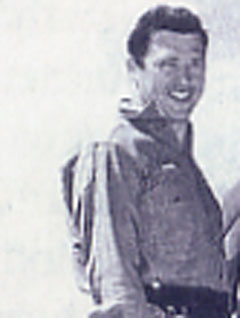
EM3 (SS)

THE SUBMARINE THAT SUNK A TRAIN
One of the most unique and little known combat actions of World War II occurred the night of July 22-23, 1945, when a small group of eight Navy men engaged in the only ground combat operation during the war to take place on the Japanese home islands. William R. Hatfield, EM3 (SS), was a valuable and essential part of the team, and the event has become known as the operation in which a submarine sunk a train.
The USS BARB (SS-220) was one of the most successful World War II submarines and during its last several patrols it was commanded by then CDR Eugene “Lucky” Fluckey, a legendary officer who was awarded the Medal of Honor and known for his brilliance and daring as a submarine skipper. Hatfield was a member of the BARB crew during its last three war patrols. During the last patrol BARB emerged victorious from a running 2-hour night battle after sinking a large enemy ammunition ship and soon thereafter the BARB successfully attacked 30 Japanese ships at anchor in a harbor with only 30-feet of water before making a daring withdrawal to open sea. The BARB also became the first submarine to fire rocket attacks against the Japanese islands. While engaged in this operation CDR Fluckey observed a railroad close to the beach where supply trains regularly shuttled supplies to equip the Japanese war machine and he decided to plan an attack on a train. The plan was simple - go ashore under cover of darkness, plant one of the sub’s 55-pound scuttling charges and blow up a supply train. This was fitting as the BARB has the philosophy, “We don’t have problems, only solutions.”
The crew enthusiastically responded to the request for volunteers and CDR Fluckey decided he needed the strong, the smart and the dependable, as well as representation from the various ratings. It was determined the group would be seven enlisted men with one officer in charge. Hatfield was chosen as he knew how to handle explosives and had been a railroad worker before joining the Navy. It may have also helped that he was a descendant of the of the fabled “Hatfield-McCoy” feuding families. He proved to be a perfect choice. As a boy Hatfield had cracked open walnuts by placing them under railroad ties so that the weight of sagging rails broke them open. Hatfield proposed to place explosives below the tracks and allow the train to blow itself up when the weight of the train depressed the track to trigger the explosion. Hatfield’s plan was adopted and he also devised a trigger switch that worked perfectly.
The night of July 22 was the night they were looking for, a small moon obscured by a heavy cloud cover. At 2200 CDR Fluckey held a final briefing and reportedly told the men, “Keep together and quiet going and returning. Don’t get cocky and try something else. I want neither prisoners nor injuries to Japanese except those positively required. Slip in and slip out without being detected. You have one mission only – bobby-trap the train and bring the men back safely. The latter is more important.” By midnight CDR Fluckey had slowly and silently brought BARB to within 950-yards of the beach with only about 12-feet under the keel. He dispatched the group with the comment, “Boys, if you get stuck, head for Siberia 130 miles to the north. Follow the mountain ranges. Good luck and God bless. Shove off.”
The men headed to the beach in two small rubber boats and at about 0030 were at the railroad track. One of the men was sent to examine a nearby water-tower-like structure. When he quietly climbed to the top he was startled to discover it was a Japanese lookout tower with a quietly sleeping sentry inside. He quickly and quietly returned to the group who were digging under the tracks. In order to dig more quietly they discarded their shovels and continued with only their bare hands. At 0047 the sound of a darken train speeding toward them was heard and they all hurtled themselves into nearby brush and ditches. Hatfield, who had been digging with his hands, leaped into a shallow ditch and felt two shots hit him as the train roared past. Thinking he had been injured he was pleased to realize that his body was slowly rising out of the ditch as the two carbon dioxide cartridges on his Mae West life jacket had gone off and inflated the vest. Within minutes the men returned to their tasks and soon buried the scuttling charge. Hatfield checked the test circuit and reported he was ready to make the final hookup. Although everyone else had been instructed to leave the area when this was done they all disobeyed the order as they watched over Hatfield’s shoulder to make sure he did things right. One of the men questioned whether the microswitch under the rail was set too far apart for the sagging rail to activate the switch. They agreed that they would never be permitted ashore again and unanimously agreed to reduce the gap distance. As they carefully did so Hatfield interrupted with the admonition, “For God’s sake, stop it before you blow us all to kingdom come!” With this the group headed for their boats at the beach and at 0132 the two boats gave a blinker signal that they were leaving the beach. By this time BARB had been very carefully brought to within 600 yards of the beach with only six-feet under the keel. At 0145, at the sight of an approaching train, CDR Fluckey grabbed a megaphone and shouted, “Paddle like the devil!”
At 0147 a tremendous flash occurred as the engine triggered the explosives and a spreading ball of flame shot skyward as the boilers of the engine blew and wreckage went flying as the 16 cars of the train began piling up into the wall of wreckage. At 0151 the two boats came alongside, the saboteurs were hoisted aboard and BARB slowly slunk away at two-knots from her victory over overwhelming odds. Over the intercom CDR Fluckey said, “All hands below deck not absolutely needed to maneuver the ship have permission to come topside.” Hatches sprang open and the crew poured forth to gawk at the chaos ashore.
For their part in this audacious commando raid each of the enlisted men, including EM3 Hatfield, was awarded the Silver Star. He was also a BARB crewmember when it was awarded the Presidential Unit Citation for war patrols #10 and #11, and the Navy Unit Commendation for war patrol #12.
Submitted by CDR Roy A. Mosteller, USNR (Ret)