

PARKINSON-FRANCIS
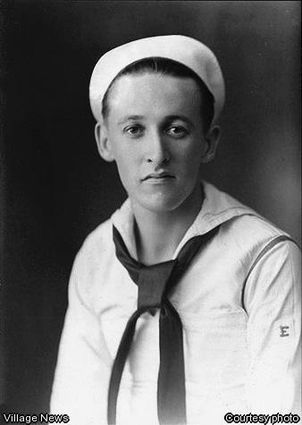
FRANCIS ROWE "PARKY" PARKINSON
WT1

SURVIVED TWO SHIP SINKINGS DURING WWII
Francis Rowe “Parky” Parkinson was born on June 5, 1919, in Kendelville, Indiana. In 1927 his family moved to Fallbrook, California, where he graduated from high school in 1938. As he did not see much of a future for himself in Fallbrook aside from picking oranges, grapefruit or avocados, with his father’s encouragement he joined the Navy in May 1939. Trained as a boiler tender, he was pleased to report as a BT2 to the battleship USS OKLAHOMA in Pearl Harbor. Parkinson said that on the morning of Sunday, December 7, 1941, the crew was “bitchin” about an important inspection scheduled for the next morning when the Battle Stations alarm sounded with the announcement, “This is not a drill.” Hurriedly proceeding to his battle station in a boiler room he saw attacking Japanese planes and remarked, “I was more ready to save me and the lives of all the others instead of being frightened. He said that as OKLAHOMA was struck by several torpedoes, he and his shipmates tried to help move the ship but quickly water started to flood the boiler room. Realizing they were in great peril as the ship began to roll over they found escape was impossible as a closed door hatch was impossible to open because of the water pressure keeping it closed. Seeking another avenue of escape Parkinson said he was fortunate when a shipmate helped him by lifting him up so he could crawl out of a small hole. When he looked back to lend a hand to the man who had assisted him it was too late as the man was already drowning. He further said that he never learned the identity of the man who he credited with saving his life. Finally reaching the outside he found himself literally on top of the bottom of the huge ship while it capsized but he had only a few seconds to think of what to do next as Japanese planes were shooting at them. Swimming to nearby Ford Island he was able to reach safety.
After the disaster of Pearl Harbor he was sent to the heavy cruiser USS NORTHAMPTON for further duty. He was aboard when NORTHAMPTON joined the task force in April 1942 for the historic Doolittle Raid on Japan and the June 1942 Battle of Midway. In November 1942 he was manning his battle station aboard NORTHAMPTON when they engaged the Japanese in the Battle of Tassafaronga. During the battle NORTHAMPTON suffered severe damage and Parkinson again found himself fleeing a sinking ship. He said that after the ship sank he was in the water about four to six hours as they swam toward a beach. Approaching land they saw splashes in the water which they thought might be fish but soon realized it was Japanese shooting from the beach. Although they were in warm shark infested waters they managed to stay afloat until finally rescued by the destroyer USS HAMPTON.
Parkinson was next assigned to the battleship USS IOWA where he remained until discharged in late 1945. After the close of World War II he became a civilian employee at the Marine Corps Base, Camp Pendleton, where he was employed for 33-years. At the time of his death on March 12, 2010, he was the longest serving member of the Fallbrook VFW Post 1924, joining in 1942. He was buried with full military honors at the Fallbrook Masonic Cemetery in Fallbrook, California.
Submitted by CDR Roy A. Mosteller, USNR (Ret)