

RHOADS-EUGENE
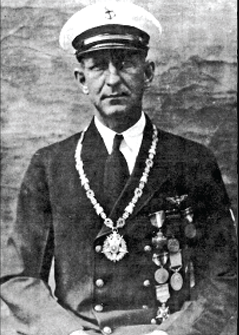
EUGENE SAYLOR "SMOKEY" RHOADS

ACMM (NAP)

ENGINEER ON NC-4 THE FIRST AIRPLANE
TO FLY ACROSS ATLANTIC OCEAN
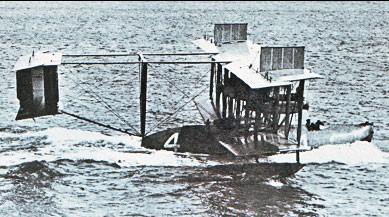
Curtis flying boat NC-4 was the first aircraft to fly across the Atlantic Ocean, albeit not non-stop. Aviation Chief Machinist Mate Eugene Saylor Rhoads was one of two engineers among the six men aboard NC-4 for the historic flight. In 1919 the Navy sought to demonstrate that floatplanes were capable of transatlantic flight, thus four NC aircraft were built. NC-2 was cannibalized for parts leaving three to begin the journey on May 8, 1919, destination Lisbon, Portugal. Their route ran to Nova Scotia, proceeded to Newfoundland, then across the Atlantic via the Azores to Portugal, and ending in England. Along the route 53 Navy ships were positioned approximately every 50 miles like a string of pearls to assist in navigation and to rescue crewmen in case of an emergency.
Unfortunately, only several days into the flight NC-1 and NC-3 were forced to land at sea because poor visibility and loss of a visual horizon making flying extremely dangerous. NC-1 was damaged landing in the rough sea and was rescued by a Greek cargo ship which took NC-1 in tow, but NC-1 sank three days later and was lost. NC-3 succeeded in taxying some 200 miles to reach the Azores but was unable to fly again. Thus, on May 20, NC-4 departed Azores alone and after another stop because of mechanical difficulties, NC-4 finally reached Lisbon on May 27, becoming the first aircraft to fly across the Atlantic. On May 31, NC-4 flew to Plymouth, England, becoming the first aircraft to fly from the United States to Great Britain.
The complete trip for NC-4 was 3,936 nautical miles and took 23 days. Flight time was 57-hours 16-minutes as the maximum speed of NC-4 was 85MPH and service ceiling was 2,500 feet. Four engine NC-4 was the largest plane in the World in 1919 and was plagued with problems during the trip. On the first leg of the flight one engine developed an oil leak and had to be shut down. Soon thereafter, a second engine suffered a failed connecting rod, so with only two functioning engines NC-4 was forced down at sea approximately 80 miles from a safe harbor to which the plane taxied. Here the broken engine was replaced. NC-4 was donated to the Smithsonian Institution but as it is too large to be housed in Washington, D.C., it is on permanent loan to the National Museum of Naval Aviation in Pensacola, Florida.
Readily available historical records reveal Eugene Saylor Rhoads was born August 20, 1891, in Somerset, Pennsylvania. He was not originally scheduled to be a member of the NC-4 crew but when crewmember Aviation Chief Machinist Mate Edward H. Howard accidentally had a hand cut off by a whirling propeller only several days prior to the flight, ACMM Rhoads replaced Howard on the crew. Historical records report Rhoads graduated from high school at the age of 14 and after working several years for a railroad company, he joined the Navy at the age of 18.
While working as a coal handler aboard a battleship Rhoads volunteered in 1913 to join the Navy’s budding aviation program. He was denied his desire to become a Naval Aviator because only officers were chosen to do so. Accordingly, Rhoads learned to fly on his own time and money, and by the time the U.S. became involved in war with Mexico in 1914 he was granted permission to fly Navy planes. A historical report reads, “For four months, he flew all over the Mexican countryside on reconnaissance, buzzing the Banditos, scaring the hell out of their horses, and ducking rifle fire in return.” The plane he flew had no cockpit, only a straight backed seat out in the open.
In 1916, Rhoads was back in Pensacola where he tested some of the Navy’s first parachutes. During World War One he flew anti-submarine patrols over the English Channel. During the historic NC-4 flight it was regularly necessary for Rhoads to climb out on the wing while wearing a safety harness to make adjustments on the engines while inflight. During 1920 after the Navy initiated a program to train enlisted personnel as pilots, Rhoads successfully completed the course and was designated Navy Enlisted Pilot #27. He retired from the Navy in April 1930 and was later reported to be employed as Chief Inspector of Naval Aircraft at Lockheed Aircraft in Burbank, California. Rhoads died April 1, 1975.
Submitted by CDR Roy A. Mosteller, USNR (Ret)