PHILLIPS-LANIER
LANIER PHILLIPS
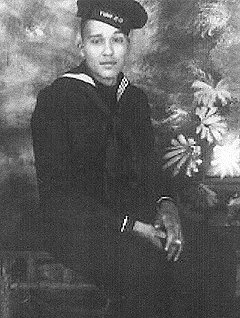

SO1

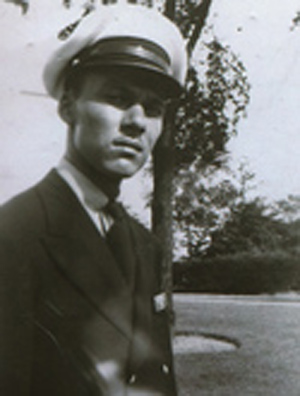
Sonar technician Lanier Phillips was born to a family of sharecroppers on March 14, 1923 in Lithonia, Georgia. He attended the Yellow River School, the only school for black children in DeKalb County, until it was burned down by the Ku Klux Klan in 1929. At the age of nine, Phillips was sent to live with relatives in Chattanooga, Tennessee, where he attended school until he enlisted in the U.S. Navy in 1941 at the age of eighteen. Phillips, like so many other young men from impoverished families, saw enlistment in the armed forces as a way to improve his prospects.
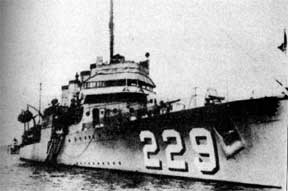
In the Navy, Phillips faced discrimination and segregation. After boot camp aboard the U.S.S. Truxtun, Phillips began working in the mess hall alongside other sailors of color. Messmen cleaned, served, shined the shoes of the officers, and generally performed tasks that were considered too menial for white Sailors. Black sailors had to eat standing up in the Messman's pantry.
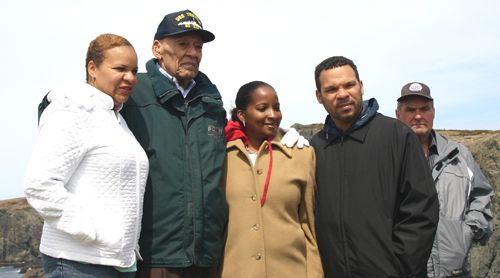
In February 1942, the U.S.S. Truxtun, the Pollux and the Wilkes ran aground, capsizing off the coast of Newfoundland. 110 aboard the Truxtun were killed, along with 93 crew members of the Pollux. The sole black survivor, Phillips found refuge aboard the last raft. A group of Newfoundland townspeople rescued Phillips and 185 white sailors. The townspeople's lack of discrimination as they cared for him was a new experience for Phillips, destined to change his outlook on race relations forever.
In 1957, Phillips became the U.S. Navy's first black sonar technician. Phillips retired from the U.S. Navy in 1961 and began work as a civil technician with EG & G, a systems engineering firm. He also began work with the ALVIN deep water submersible team. Phillips later joined the deep sea exploration team of Jacques Cousteau and assisted in the development of deep sea lamp technology.
During the 1960s, Phillips marched with Dr. Martin Luther King, Jr. in Selma, Alabama. In 1977, after his wife's death, Phillips sought relief from the growing racial tensions of northern cities, moving his family to his hometown of Lithonia, Georgia.
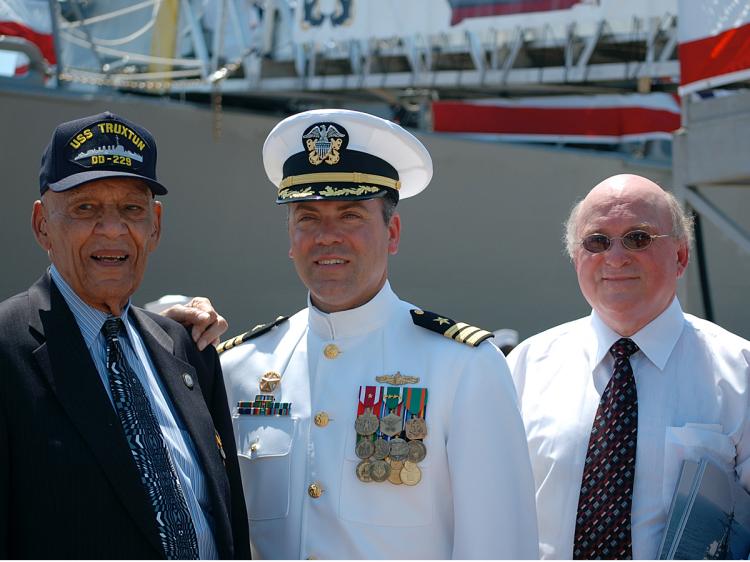
Phillips lives in Washington, D.C. where he continues to lecture about the U.S.S. Truxton disaster. A playground in Newfoundland was named in his honor.
(Sources: The History Makers, Memorial University, Military.com)