

WHITE-WILLIAM
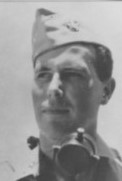
WILLIAM GARDNER "TED" WHITE
LTJG

LOST AT SEA
Chichi Jimi Island is 620 miles south of Tokyo and part of the Bonin Island Group. The island is small, only five miles by three miles in size but during World War II the island was critical to the Japanese communications services who used it as a strategic radio relay link. By the end of the war the island was defended by approximately 23,000 Japanese troops when the Navy began routine bombing raids to neutralize its defenses.
On September 2, 1944 a flight of four TBM Avenger torpedo bombers assigned to Torpedo Squadron Fifth-One departed the carrier USS San Jacinto to conduct a bombing raid on Chichi Jimi Island. Accompanying the bombers for protection was a flight of Hellcat fighter planes. One of the bombers, TBM-1C BuNo 46214, was piloted by LTJG George H. W. Bush (who later became the 41st President of the United States). Accompanying him was LTJG William Gardner White, turret gunner, and Aviation Radioman Second Class John L. Delaney, radioman. LTJG White’s regular squadron assignment was Weapons Officer but for this flight, for reasons unknown, he replaced the flight crew’s regular turret gunner. During the attack the Avengers encountered intense antiaircraft fire, and in an autobiography later published by LTJG Bush, he wrote the following:
“The flak was the heaviest I'd ever flown into. The Japanese were ready and waiting. Their antiaircraft guns were set up to nail us as we pushed into our dives. By the time VT-51 was ready to go in, the sky was thick with angry black clouds of exploding antiaircraft fire. Don Melvin led the way, scoring hits on a radio tower. I followed, going into a thirty-five degree dive, an angle of attack that sounds shallow but in an Avenger it felt as if you were headed straight down. The target map was strapped to my knee, and as I started into my dive, I'd already spotted the target area. Coming in, I was aware of black splotches of gunfire all around. Suddenly there was a jolt, as if a massive fist had crunched into the belly of the plane. Smoke poured into the cockpit, and I could see flames rippling across the crease of the wing, edging towards the fuel tanks. I stayed with the dive, homed in on the target, unloaded our four 500-pound bombs, and pulled away, heading for the sea. Once over water, I leveled off and told Delaney and White to bail out, turning the plane to starboard to take the slipstream off the door near Delaney's station. Up to that point, except for the sting of dense smoke blurring my vision, I was in fair shape. But when I went to make my jump, trouble came in pairs.”
Historical records contain conflicting information concerning LTJG White and ARM2 Delaney. Some records state that both men managed to exit the falling plane but that only one parachute opened. Others state that only one man exited the plane and was observed parachuting into the ocean. However, all records are consistant in reporting that both men were killed during the incident and their bodies were not recovered. The names of LTJG William G. White and ARM2 John L. Delaney are both engraved in the Courts of the Missing at the National Memorial Cemetery of the Pacific in Honolulu, Hawaii. Only LTJG Bush managed to survive the crash and waited about four hours in the ocean before he was successfully rescued by the USS Finback on submarine lifeguard duty.
LTJG William Gardner White was reportedly born on February 25, 1918 in Minnesota. He graduated from Yale University (Class of 1942) and participated in the Navy ROTC program while there. Records reflect he was commissioned as Ensign on June 15, 1942, was promoted to Lieutenant Junior Grade on January 1, 1944, and died on September 2, 1944 although he was reported as “missing in action” and not declared dead by the Navy until September 3, 1945. He was survived by his parents residing in White Bear Lake, Minnesota.
Submitted by CDR Roy A. Mosteller, USNR (Ret