

WILLY-WILFORD
WILFORD JOHN WILLY
LT

KILLED IN ACTION
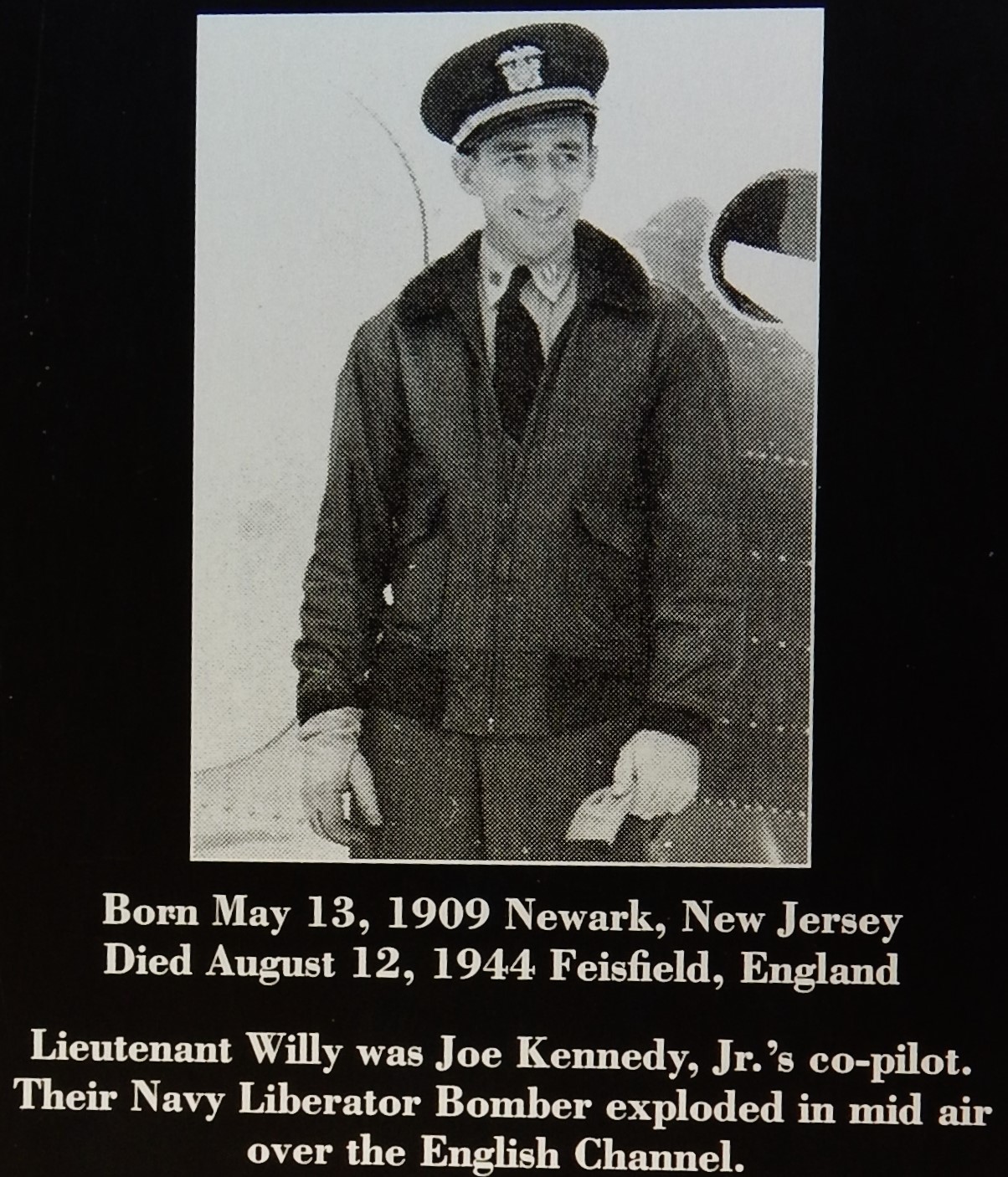
Wilford John Willy was born on May 13, 1909 in Newark, New Jersey. He enlisted in the Navy in May 1928 from Texas and became a Navy Enlisted Pilot, gaining his wings on April 30, 1937. Advancing through the rank of Chief Petty Officer, Wiley was promoted to Lieutenant Junior Grade on April 28, 1942, and two months later, on June 26, 1942 he achieved the rank of Lieutenant. In June 1944, as Allied forces advanced ashore and commenced their battles toward Germany, a secret plan codenamed Project Aphrodite was developed to attack targets on the continent. The mission involved converting four-engine bombers into drones and packed with explosives these robots, controlled by a nearby mother plane, would fly into targets after the two drone pilots had bailed out.
LT Willy became an expert in radio operations and procedures, and thus became the Executive Officer of the Special Air Unit One (SAU-1) of Bombing Squadron 110 (VB-110), a unit participating in Project Aphrodite. LT Willey volunteered to be the copilot aboard a PB4Y-1 Liberator BuNo 32271 (ex-USAAF B-24J) to be piloted by LT Joseph P. Kennedy, Jr. (older brother of John F. Kennedy who became the 35th U.S. President). The plane was filled with 21,270 pounds of explosives and took off at 6:07pm on August 12, 1944 from RAF Fersfield, England, to attack the German V-1 rocket launching sites at Mimoyecques, Northern France. The plane was followed by two mother planes higher and slightly behind, two Mosquitos, one for monitoring the weather and the second to photograph, a P-38 high altitude photo reconnaissance aircraft, and five P-51 Mustangs to provide fighter cover. Once airborne the “baby” climbed to about 2,000 feet and on reaching the first control point the group began to turn south. About two minutes after the turn, LT Kennedy was heard by radio to give the code signal turning over control of his plane to a “mother” but at 6:20pm his plane disintegrated over Suffolk, England, in what was described as “two mid-air explosions” and a “large fireball.”
Both LT Kennedy and Lt Willy were instantly killed in the explosion. Many months of investigations followed, but no firm conclusions could be drawn as to the precise cause of the explosion that caused the plane to disintegrate and shrapnel to strike a Mosquito that followed about 300-feet away. A number of speculative theories were advanced, but the most plausible is that the electrical arming system was faulty and when LT Kennedy or LT Willy activated the switch, an electrical short occurred that caused the bombs to detonate. The film that was in the following Mosquito has never been seen or made public – if indeed it was filming at the time of the explosion. The names of LT Kennedy and Lt Willy are inscribed in the Tablets of the Missing at the American Cemetery and Memorial in Cambridgeshire, England, and LT Willy’s name is also inscribed on a memorial cenotaph at Greenwood Memorial Park in Fort Worth, Texas. Both men were posthumously awarded the Navy Cross. Lt Willy left a widow and three children.
NAVY CROSS CITATION
The President of the United States of America takes pride in presenting the Navy Cross (Posthumously) to Lieutenant Wilford John Willy (NSN: 0-137078), United States Navy, for extraordinary heroism in operations against the enemy while serving as Co-Pilot of a Navy Liberator Patrol Plane in Bombing Squadron ONE HUNDRED TEN (VB-110), Special Air Unit ONE (Europe), during a special air mission directed at Mimoyecques, France, on 12 August 1944. Well knowing the extreme dangers involved and totally unconcerned for his own safety, Lieutenant Kennedy unhesitatingly volunteered to conduct an exceptionally hazardous and special operational mission. Intrepid and daring in his tactics and with unwavering confidence in the vital importance of his task, he willingly risked his life in the supreme measure of service, and, by his great personal valor and fortitude in carrying out a perilous undertaking, sustained and enhanced the finest traditions of the United States Naval Service.
Submitted by CDR Roy A. Mosteller, USNR (Ret)